


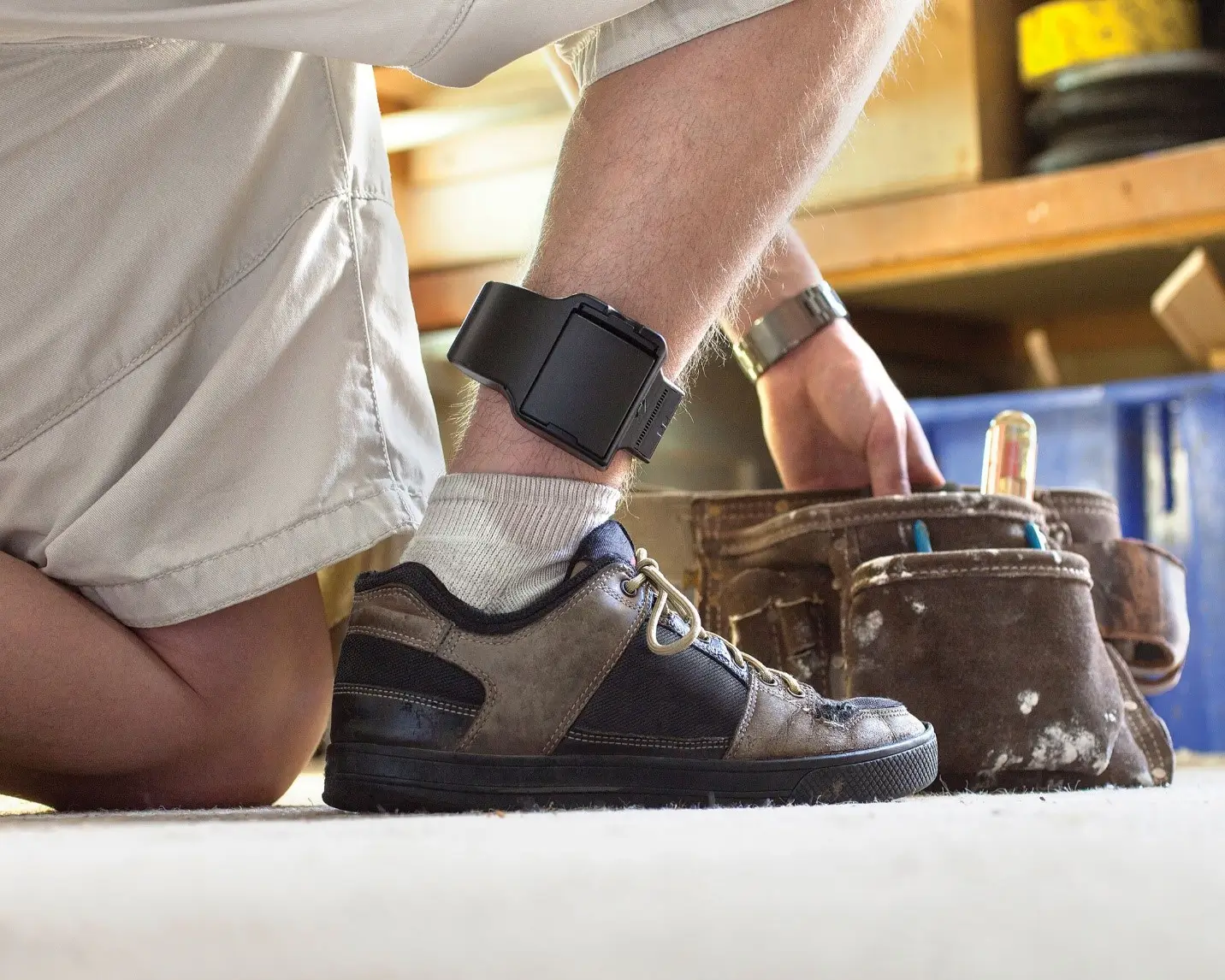
Control measures sound administrative. They can mean an ankle tag, contact bans and a duty to report to the police for someone no court has convicted, because the state judges that person dangerous.
Table of contents
Several European states already run versions of this. What separates them is what the state has to show first, and who checks it. A Danish bill under consultation would add ordered psychiatric or psychological treatment on the strength of an intelligence service’s assessment.
What a court is asked to check
Where a judge signs the order, that matters. It also moves the criticism more than it removes it.
Read also: Europe’s Surveillance Rules Are Being Written Around the Exceptions
In an ordinary case the court asks whether a crime was committed and proven. Under a control regime it is asked to rule on a threat assessment from the authorities, and the basis for that assessment is, as a rule, secret. That is a different job from the one courts normally do, and it is the difference lawyers keep pointing to.
Three systems, three tests
United Kingdom. Terrorism Prevention and Investigation Measures have existed since 2011, when they replaced control orders. The package includes an electronic tag. The Home Secretary imposes the measures, and the High Court sanctions and reviews each notice, partly on closed evidence heard with special advocates in the subject’s absence.
The legal trigger is involvement in terrorism-related activity, a defined test and not a label like “radicalised”. The numbers stay small: three notices were in force at the end of February 2025. And the UK’s independent reviewer of terrorism legislation reported in 2013 that four of the first subjects had previously been acquitted of terrorism charges.
France. Administrative control orders, known as MICAS, have been in force since the state of emergency ended in 2017. The interior minister, not a judge, issues them, and an administrative court reviews afterwards. They can include electronic tagging.
France’s Constitutional Council accepted the regime in large part in February 2018, but struck down parts of it, and it counted the twelve-month limit on the measures in its assessment. A parliamentary review in 2021 counted 349 orders against 301 people.
Germany. Since the 2017 reform of the Federal Criminal Police Office (BKA) law, a judge can order an ankle tag on a “Gefährder”, a person expected to commit serious politically motivated crime. The trigger is specific facts that justify assuming the person could carry out an attack, or behaviour pointing that way.
The reform followed a 2016 ruling by the Federal Constitutional Court that parts of the BKA’s counter-terror powers were unconstitutional and needed precise rules. According to German media, a BKA spokesperson has said the option has never been used.
Read also: Europe’s New Migration Rules Turn Borders Into Waiting Rooms
Strasbourg. The European Court of Human Rights points in two directions. In S., V. and A. v. Denmark (2018), the Grand Chamber found no violation when Danish police held football supporters for about eight hours without charge to prevent a brawl. So Strasbourg accepts preventive measures against people who are not charged. But that case was measured in hours and tied to a specific event, and the Court treated prompt judicial control as a matter of hours too.
On treatment, the Court’s 1979 judgment in Winterwerp v. the Netherlands sets the floor for confining someone as being of unsound mind: a true mental disorder shown by objective medical expertise, of a kind that warrants confinement, and persisting. An outpatient order is not confinement, so Winterwerp does not settle the question, but it does show what Strasbourg wants in hand before the state treats a person as mentally disordered: medical evidence, not an intelligence assessment.
What it means if you are not radicalised
The easy reply is that it will never touch anyone who is not radicalised. Probably true today. Legal safeguards are written for the case where it does.
A system where court control means approving a closed threat assessment guarantees nothing to the individual, however far from the target group that person feels.
Britain and France do tag or restrict people without a conviction, under a defined statutory test and, in France, a time limit. Germany allows it on paper and seems never to have used it. As Danish consultation responses read the bill, it hangs the measure on a bare label, “radicalised”, that none of them has been able to define. And once a mechanism exists, the question is who gets defined into it next.
BASIS OF ANALYSIS
Basis of analysis. The analysis rests on ten sources. Six are primary or official: the European Court of Human Rights judgment in S., V. and A. v. Denmark, a Council of Europe paper on involuntary placement, the French Conseil constitutionnel decision no. 2017-691 QPC (via Dalloz), a report from the French National Assembly law committee, UK House of Commons records and the UK Independent Reviewer of Terrorism Legislation on TPIMs. The Danish bill is reported by Kristeligt Dagblad and Politiken and in Justitia’s consultation response, all in Danish, and the German debate by Legal Tribune Online and blue News, in German.
Sources
- Kristeligt Dagblad/Politiken: Minister bekræfter lov om fodlænke på ustraffede — the justice minister’s confirmation of the bill.
- Justitia: Høringssvar til lov om kontrolforanstaltninger — the think tank’s criticism of the break with legal-certainty principles.
- UK House of Commons: Terrorism Prevention and Investigation Measures, 1 December 2024 to 28 February 2025 — three TPIM notices in force.
- Independent Reviewer of Terrorism Legislation: The operation of the TPIM Act 2011 — the regime’s structure and subjects, including four earlier acquittals.
- Conseil constitutionnel: Décision n° 2017-691 QPC du 16 février 2018 — the French court’s ruling on MICAS.
- Assemblée nationale, commission des lois: compte rendu on the application of the SILT law — 349 MICAS against 301 people.
- Legal Tribune Online: Fußfessel für Gefährder soll kommen — the 2017 BKA law reform and the 2016 constitutional ruling.
- blue News: Fußfessel, Gewahrsam, Strafrecht — the BKA spokesperson on the power never having been used.
- European Court of Human Rights: S., V. and A. v. Denmark, Grand Chamber, 22 October 2018 — preventive detention of uncharged football supporters.
- Council of Europe: Rights of persons in relation to involuntary placement and treatment — the three Winterwerp conditions.