


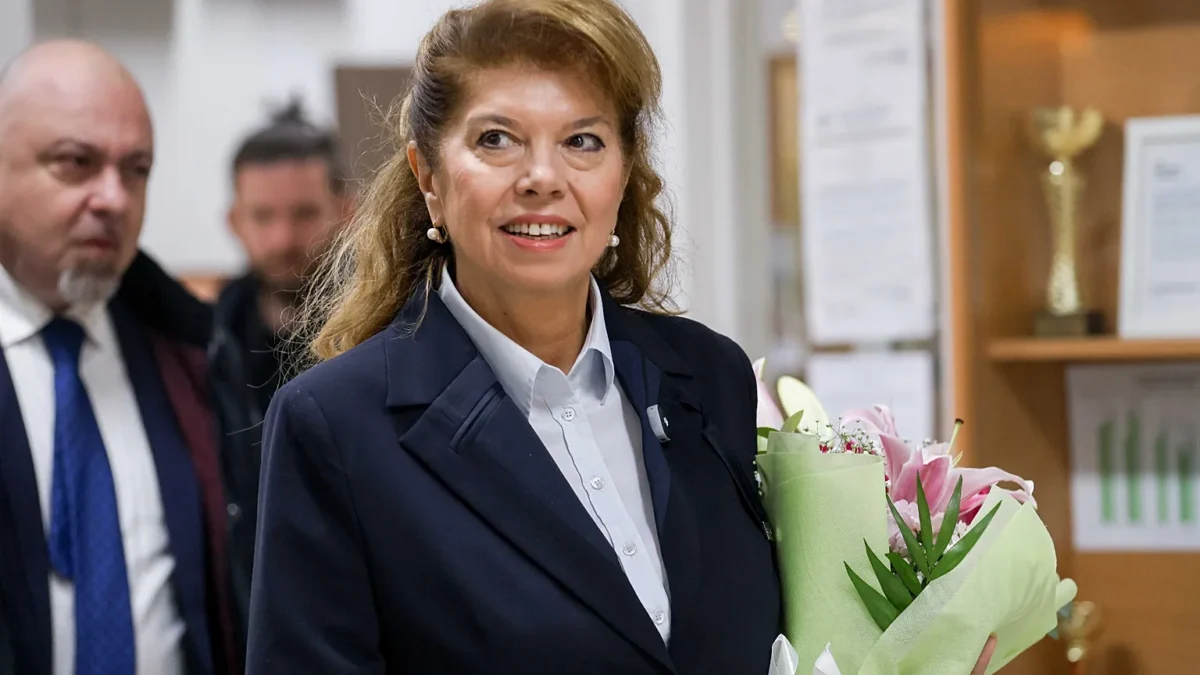
Bulgaria has elected Iliana Yotova president, and a NATO and EU member on the Black Sea now has a head of state who favours dialogue with Moscow and opposes military aid to Ukraine. With 99.95 percent of protocols processed, the Central Election Commission gave her 57.58 percent against 39.47 percent for Andrey Gyurov, a former caretaker prime minister who ran on a pro-EU, pro-NATO platform.
Table of contents
A landslide the exit polls missed
Exit polls on Sunday evening had Yotova at about 52 percent, and one of them put Gyurov at 43.4 percent. The count ended more than five points higher for her and almost four points lower for him. Parallel counts by polling firms later that night already showed her at 57 to 58 percent.
Read also: A Sanctioned Tanker Sits Off Bulgaria. Europe’s Port Checks Would Not Have Stopped It
In the first round on 25 October the two were close, Yotova on 35 percent and Gyurov on 32. After the runoff Gyurov conceded: “This is how the Bulgarian citizens have voted.” GERB’s Borissov said he voted for Gyurov but did not call on his supporters to do the same.
A big margin on a small electorate
Turnout was about 27 to 29 percent, up from a record-low 23 percent in the first round. That means most Bulgarians stayed home both times. Low turnout does not affect the legal validity of the result, but it raises questions about the political weight of her mandate.
What the president can actually do
The Bulgarian presidency is largely ceremonial. The president commands the armed forces, sets the dates of parliamentary elections, appoints caretaker governments when needed and holds a limited veto that a parliamentary majority can override. Major policy needs the approval of parliament.
Executive power sits with the government of Prime Minister Rumen Radev, whose party, Progressive Bulgaria, backed Yotova’s campaign. She was his vice president for years. She takes up the elected office in January 2027 for a term of five years.
The Russia policy is already in place
Radev’s government has ended military support for Ukraine from army stocks and left the French and British led Coalition of the Willing. It has been reluctant to blame Russia openly for drone attacks on shipping. Radev said the attacks “appear to serve Russian interests”, while his government said there was no evidence directly linking them to Moscow.
Read also: Putin call splits the Nordics and the EU
Yotova campaigned on a “coalition for peace” and has said peace “can come only through negotiations”. Gyurov’s line was: “Russia must stop its aggression so that the next steps can be taken.” Analysts expect Yotova to call for better relations with Russia and the lifting of sanctions, but the sources give no statement from her on sanctions.
Ursula von der Leyen congratulated her on the victory and said she looks forward to “continuing our joint work”. The presidency gives Yotova a voice, a limited veto and the right to name caretaker governments, and no executive power over the course Radev has already set.
SOURCES & METHOD
How this article was made. The article rests on six sources, none of them the election commission’s own results page. Final turnout and the commission’s closing count could not be confirmed.
Sources
- Kyiv Independent: Russia-friendly Yotova wins Bulgaria’s presidential runoff (2 Nov 2026) – Central Election Commission count, turnout, Radev government policy.
- Al Jazeera: Initial results indicate victory for Iotova in Bulgarian presidential vote (1 Nov 2026) – exit polls, candidates’ positions, drone attacks on shipping.
- Euronews: Initial results show Bulgaria’s acting president Yotova wins runoff election (1 Nov 2026) – exit polls, powers of the presidency, analysts’ expectations.
- The Sofia Globe: Bulgaria’s 2026 presidential elections, Yotova 52.5%, Gyurov 43.4% (1 Nov 2026) – exit poll figures, constitutional powers, party positions.
- Novinite: Bulgaria Elects First Woman President as Yotova Defeats Gyurov in Runoff (1 Nov 2026) – parallel counts, reactions, turnout and mandate.
- AP via WPRI: Polls open for Bulgarians in presidential election (25 Oct 2026) – first round, candidates’ backgrounds.