



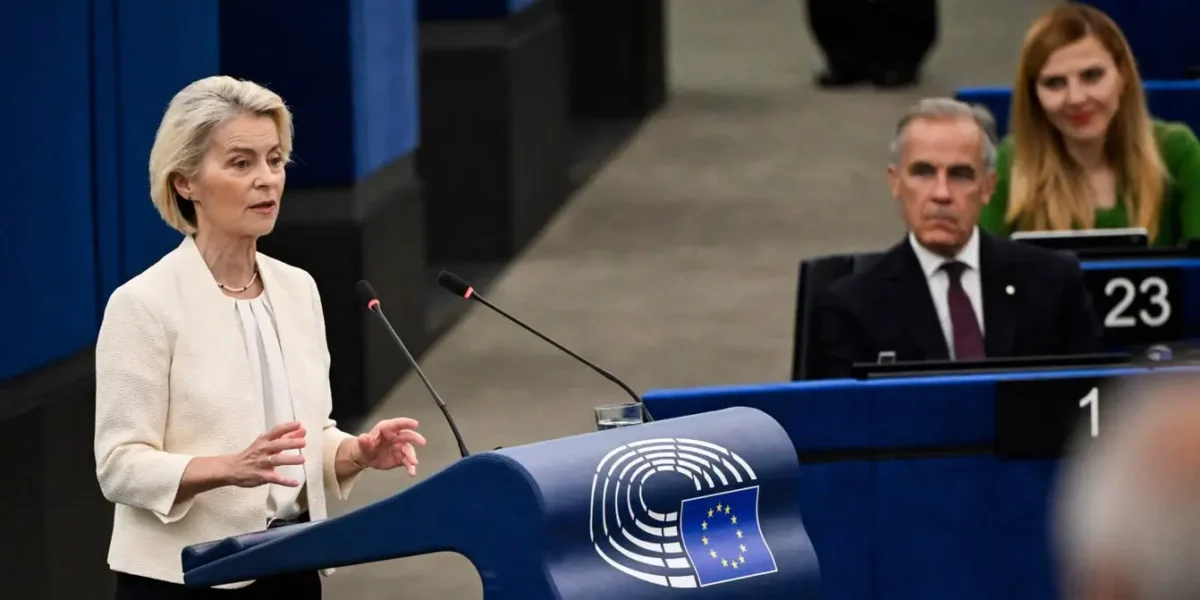
The idea that Canada could become the EU’s first associate member did not survive its first test. A draft joint declaration for the EU-Canada summit in Montreal drops the label. Germany led the member states that objected to a status with no legal basis in the treaties and no agreed content, according to diplomats.
Table of contents
Ursula von der Leyen floated the idea about six weeks ago. The summit runs on 29 and 30 October, and the declaration is due to be published on 30 October, so the final wording may still change.
What von der Leyen proposed
She made the offer on 16 September in her State of the Union speech in Strasbourg, with Canadian Prime Minister Mark Carney in the audience. She told him she wanted to work on “opening the door for Canada being the first associate member of the EU.” The speech gave no definition, and member states would have to agree on what the status contains.
At the time, seven EU diplomats said no detailed plan for a broader relationship with Canada had been discussed at a high level. Carney had already ruled out full membership on 13 September and said Canada wants a “unique alliance” with the EU.
Who objected, and why
Germany led a group arguing it could not endorse a concept without legal status or a developed framework. Diplomats also worried that the label would raise expectations among other non-EU countries seeking closer ties.
Read also: EU Leaders Want New Trade Tools Against China
Germany, France, Italy and Greece raised objections to an earlier draft circulated under the silent procedure. Italy’s concerned a separate paragraph on competitiveness and technological sovereignty. An earlier draft contained at least two references to Canada as an associate member.
Germany and France opposed the idea, and a European diplomat said: “We don’t know what ‘associated membership’ is.”
What the declaration says instead
The revised text commits both sides to a closer association between Canada and the EU, and officials will keep defining the relationship until the next summit in 2027. It also contains a joint initiative on connectivity between Europe, Canada and Asia through new subsea cable infrastructure and a joint feasibility study on Canadian liquefied natural gas exports to Europe.
Further items include programmes that let young Canadians and Europeans work across the Atlantic, and a pledge to uphold a rules-based international order, with regret over US sanctions on the International Criminal Court. The Alliance for the Future, Carney’s framework for economic, technological and strategic cooperation, continues.
The American factor
US President Donald Trump called the associate member idea laughable and warned of possible trade measures against Europe if it were seen as hostile. Canada ships nearly 70 percent of its exports to the United States, and the EU accounts for about 9 percent of its total trade.
The proposal came after Canada-US trade talks collapsed and the US imposed 50 percent tariffs on about C$28 billion of Canadian goods on 22 August.
Read also: Putin call splits the Nordics and the EU
Carney said: “What matters is the difference it will make to the lives of Canadians.” He added that further formal negotiations would take about another year.
The trade lawyer Barry Appleton called the statement provocative towards Washington, and the former finance ministry adviser Julian Karaguesian called the summit a show.
The unfinished trade deal
The EU’s own business with Canada is also incomplete. The trade agreement CETA has been provisionally applied since 2017, but 10 member states, including France, Italy, Belgium and Ireland, have not ratified it. The same pattern appeared in May, when Germany floated associate membership for Ukraine and capitals reacted coolly.
What to watch
The published declaration will show whether any reference to associate membership remains. If it does not, von der Leyen’s proposal ended as a topic for the 2027 summit with nothing agreed. The practical results are the subsea cable, LNG and youth mobility items, which are modest next to the language used when the idea was launched.
SOURCES & METHOD
How this article was made. It rests on five sources. The draft declaration is described by Reuters and IBTimes, not read directly, and the final text had not been published when this was written. The speech text was not read directly. France 24’s report on the outcome was not available.
Sources
- Reuters via ThePrint: Canada, European Union officials drop ‘associate member’ from joint summit declaration (28 October 2026) – the draft, the deliverables, Carney, Trump’s reaction and trade shares.
- IBTimes UK: Canada loses shot at proposed EU ‘associate member’ status (October 2026) – Germany’s legal objections, the earlier draft and the silent procedure.
- Brussels Signal: Von der Leyen announces plan to make Canada the EU’s first associate member (September 2026) – the speech, Carney’s reaction, CETA and the tariffs.
- Reuters via Business Day: EU’s von der Leyen wants Canada to become bloc’s first associate member (16 September 2026) – the diplomats and the Ukraine precedent.
- Il Foglio: Von der Leyen’s proposal to Canada fizzles out, Carney’s plan is on the table (24 October 2026) – the Alliance for the Future and the diplomat’s remark.