


Banks, hospitals and mobile networks across Europe depend on a few strands of fibre lying on the seabed. A Telegraph investigation published on 21 October reports that Russian trawlers have idled above some of them for hours. The paper adds that no law prevents Russian ships from surveying cables in international waters. For the countries around the Baltic and the North Atlantic, that gap is not abstract.
Table of contents
The Telegraph says it cross-referenced four and a half years of satellite tracking data from Global Fishing Watch with cable charts and found 17 Russian fishing vessels that spent long periods at low speed near charted cables. Naval sources say slow movement is what a vessel would do to map the seabed with sonar or a tethered underwater drone.
Slow movement is also what a fishing boat does when it fishes, and the Telegraph has not published its method. Treat the pattern as a lead, not a verdict.
What follows is what the public record adds, especially from the Baltic and the Nordic seas.
Brussels named names more than a year ago
On 20 May 2025 the EU Council listed two Murmansk fishing companies, Norebo and Murman Seafood, in its 17th sanctions package. Its stated reason: their vessels show movement patterns inconsistent with fishing, and some carry technology that may be used for espionage.
Read also: A Sanctioned Tanker Sits Off Bulgaria. Europe’s Port Checks Would Not Have Stopped It
Norway followed and closed its ports and territorial waters to both. Norebo denies everything and calls itself entirely non-political, and its owner Vitaly Orlov has sued Norway over the ban. Murman Seafood owns the trawler Melkart-5, which Norwegian reporting has linked to suspected damage to a cable between mainland Norway and Svalbard. Britain has sanctioned neither company.
Finland’s courts said no, then yes
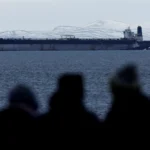
The one court test so far involved a tanker, not a trawler. On 25 December 2024 the Eagle S, which Western governments associate with Russia’s shadow fleet, dragged its anchor roughly 90 kilometres across the Gulf of Finland seabed. Five cables were damaged, among them the Estlink 2 power link between Finland and Estonia.
In October 2025 the Helsinki District Court dismissed the case against the captain and two officers. The damage lay in Finland’s exclusive economic zone but outside its territorial waters, and the court held that the law of the sea leaves jurisdiction with the flag state, the Cook Islands, or the defendants’ home countries.
The Helsinki Court of Appeal reversed that unanimously in August 2026. It found the events were not a maritime accident under the UN Convention on the Law of the Sea, because the consequences struck Finland and because of what the crew did after Finnish authorities made contact: they reported both anchors secured while the ship kept dragging. The court accepted that the first anchor drop might have been an accident.
The case now goes back to the district court. The ruling is not final, and the Supreme Court can still take it up if it grants leave. The three men have left Finland.
That is a real shift. It is also a narrow one. The hook was the crew’s conduct after being contacted, plus the damage. A trawler that slows down above a cable gives a court neither.
Europe’s narrow seas limit what states can do
Every Baltic route runs through the Danish straits, and geography cuts both ways. Foreign Minister Lars Løkke Rasmussen has said a blockade of shadow-fleet tankers would not hold up legally, because Denmark must let ships pass through the Øresund and the Great Belt. Copenhagen has instead built a coalition behind mandatory insurance documentation for Baltic tankers. These measures aim at tankers. Nothing in them reaches a fishing vessel.
Read also: Latest Russian Takeover Goes to a Months-Old Manager
The Danish Defence Intelligence Service (FE) describes the same pattern across the Nordic seas. A summary of its 2025 risk assessment says foreign states, Russia in particular, are systematically mapping critical infrastructure in Denmark and the Nordic seas so they can sabotage it in an escalating conflict with NATO.
Britain sees it from the other side of the North Sea. The tracking data shows one vessel sailing a cable route through the zone where British and Faroese waters overlap, and another approaching the Atlantic Crossing 1 cable from the north, near the Faroe Islands.
Each coastal state holds a piece of the answer: sanctions in Brussels and Oslo, a court in Helsinki, tanker insurance rules around the Danish straits. None of them has a rule that covers a trawler idling above a cable.
What nobody can do yet
Estonia’s navy has said it will stop detaining shadow-fleet ships, after an attempt to board one ended when a Russian fighter jet flew low over the tanker. Sanctions, tracking and publication are what is left.
Russia’s legal ground is deliberate. In July 2022 Putin approved a maritime doctrine ordering authorities to improve the “mobilised capabilities” of fishing and special vessels. Mariia Vladymyrova, a University of Copenhagen scholar who studies Russian maritime strategy, says the doctrine indicates fishing vessels will be more integrated into the naval posture of the state.
Courts have now shown they can reach an anchor dragged across a seabed once a crew lies about it. A trawler that only slows down gives them nothing to hold on to.
SOURCES & METHOD
How this article was made. The article rests on five sources, all media or trade outlets: The Telegraph, the Independent Barents Observer, The Record and two Danish outlets (Maritime Danmark and Lovguiden), which are in Danish. No court ruling or official document is among the sources.
Sources
- The Telegraph: “Putin sends fishing trawlers to spy on Britain” (21 October 2026)
- The Independent Barents Observer: “Brussels imposes sanctions on Murmansk fishery industry”
- The Record: “Finland appeals court revives case against Eagle S”
- Maritime Danmark: “Danish initiative to stop the Russian shadow fleet” (in Danish)
- Lovguiden: “The threat picture against Denmark has become more serious” (in Danish)