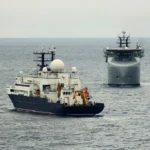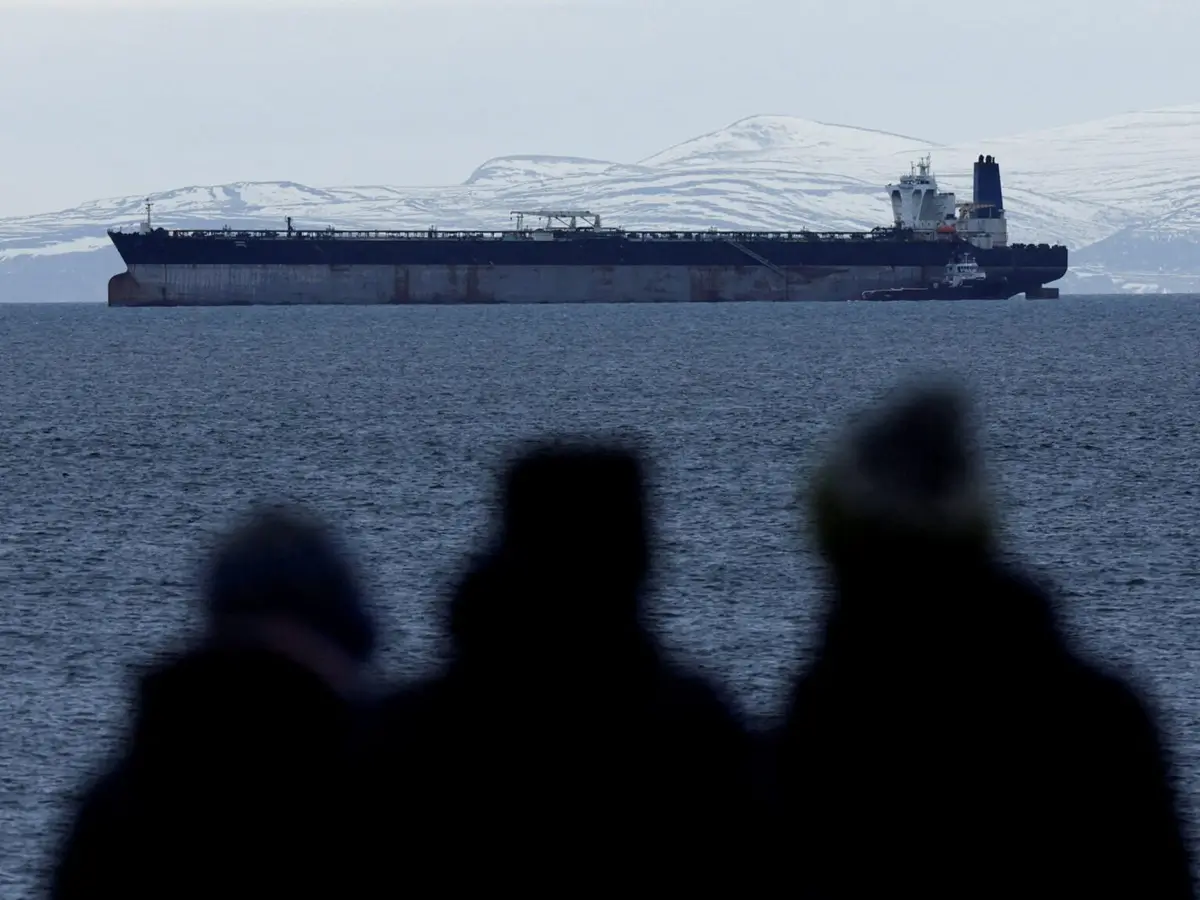
Less than a nautical mile off the Bulgarian coast, in Burgas Bay, a burnt-out crude tanker called Kairos sits at anchor. Drones hit it in the Black Sea in November 2025. It carries sanctions from both the EU and the UK. Since spring, satellite images have shown oil-coloured slicks nearby, and the Bulgarian authorities say they cannot link them to the ship.
Table of contents
The Kairos is one ship. The question it raises is for every coastline in Europe: what does a port or coastal state actually check when a sanctioned tanker turns up? Danish Maritime Authority inspection figures, obtained through access-to-information requests, point to an uncomfortable answer. Inspectors check the ship’s papers and its condition today. They do not check what the ship has been doing for the past three years.
A wreck with a paper trail
The Kairos is a 150,000 dwt crude carrier built in 2002, reportedly registered in Gambia and owned by a Chinese company. Drones struck it north of Turkey on 28 November 2025. Ukrainian security service sources, cited by CBS News and Bloomberg, said Sea Baby naval drones were responsible.
Read also: Who Really Runs the EU? The Answer Depends on the Room
Turkish authorities helped evacuate the crew and the hulk was taken under tow. On 5 December it grounded on the Bulgarian coast, and reports claim the towing tug left it in Bulgarian waters. About ten days later it was moved to a more sheltered anchorage in Burgas Bay, where it has stayed. The owners now say it has been sold, reportedly to a cash buyer who will resell it for scrap in Turkey.
Satellites see slicks, inspectors see “individual spots”
The Nessebar Public Council, about 20 nautical miles north of the wreck, raised the alarm in July. Greenpeace Bulgaria then presented an analysis of Sentinel-1, Sentinel-2 and PlanetScope images. It traces a slick to an image from 26 April 2026 and lists further spots on 14, 15, 17, 19 May and 21 July. It puts the length at about 6.5 nautical miles. Coordinator Martin Tomov says that with a high degree of confidence the stains are petroleum products.
The Transport Ministry and the Maritime Administration reported on 22 July that two inspections within 1.5 nautical miles of the tanker found no slick. Inspectors did see “individual coloured spots” and treated them with dispersant. A hull survey showed no active leaks.
Greenpeace is an advocacy group and its analysis needs independent verification, ideally chemical analysis of water samples and an on-site inspection, which the organisation itself requests. The authorities, for their part, say they are monitoring the ship.
Skagen: 219 inspections, eight detentions
Russian crude leaving the Baltic ports passes through the Danish straits, and many tankers anchor off Skagen. In February 2025 Denmark announced that tankers anchoring at Skagen Red outside harmless passage would be inspected as port state control cases. Figures obtained through access-to-information requests show 219 inspections of 200 ships since then, ending in eight detentions.
Researcher Kristina Siig says these controls are not suited to actually stopping the shadow fleet. The reason is built into the tool. Port state control asks whether a ship meets safety, environmental and crew standards on the day: is the insurance certificate valid, is the hull sound, are the lifeboats where they should be?
A tanker that passes can still have loaded cargo from a sanctioned terminal last week. Coast Buster, detained at Skagen and linked by analysts to the Russian terminal at Tuapse, which Ukrainian drones had attacked, is on no sanctions list. We cannot say what it carried, and neither could the inspection.
Elsewhere in Europe: the same gap
Across the continent, states are probing how much a coastal country can do to a ship that most of the world still treats as lawful.
Read also: Brussels Fined Big Tech 2.46 Billion. Washington Threatens Tariffs
The size of the problem. The 21st EU sanctions package, adopted on 23 July 2026, listed 41 more vessels on top of the 632 already designated. Broker estimates from August 2025 put the shadow tanker fleet at about 1,140 ships, more than 18 percent of the world’s tankers. The EU’s list therefore covers a minority of the vessels involved.
Insurance checks. In December 2024 twelve European countries announced they would check insurance certificates for suspected shadow tankers, and six (the UK, Denmark, Sweden, Poland, Finland and Estonia) began inspections in the Channel, the Danish straits, the Gulf of Finland and the Kattegat.
By April 2025 Estonia had asked more than 500 vessels for proof of insurance. By January 2026 the UK had asked more than 600. The Atlantic Council reports that by late February 2026 about a third of oil tanker transits across the Baltic carried cover from sanctioned or Russia-linked insurers.
False flags. Estonia detained the Kiwala in April 2025, a ship that claimed a Djibouti flag but was not registered there. France detained the same ship under the new name Boracay in early 2026, and a court convicted its Chinese captain in absentia in March 2026 for refusing to obey instructions. Reporting in February 2026 counted more than 500 vessels sailing without valid flag registration.
Courts. Finland boarded the Eagle S after it damaged four data cables and an interconnector in the Gulf of Finland on 25 December 2024. Repairs to EstLink 2 alone were estimated at about 60 million euros. A Finnish court later ruled that Finland had no jurisdiction over the captain and two mates. A boarding that makes headlines does not guarantee a case that survives in court.
The legal pattern is plain. Inside territorial waters, a coastal state can inspect and detain on technical grounds. Outside them, it needs a reason under the law of the sea, and sanctions alone do not provide one. A ship with no valid flag can be stopped. A ship with a real flag, even Russia’s, usually cannot.
The law that should close the gap
An EU directive of 2024 requires member states to treat serious sanctions violations as criminal offences. The transposition deadline was 20 May 2025. In theory this moves the question from “are the papers in order?” to “who is liable for what the ship carried?” In practice, a criminal case needs evidence of what was loaded, from where, and who knew. Port state inspectors are not trained or equipped to collect it, and the inspection regimes were not designed for it.
That is the real lesson of the Kairos and of Skagen. Europe has built a system that is good at checking whether a ship is safe and weak at establishing where a ship has been. The shadow fleet is the product of that difference.
When an old tanker leaks, the coast pays
An old tanker with uncertain insurance and a damaged hull is a risk to a coast regardless of its sanctions status. If it leaks, the clean-up falls to the coastal state, which in practice means the taxpayer and local tourism. The Kairos is waiting for a tow to the scrapyard, but the questions about what happened while it sat in Burgas Bay will outlast the tow.
BASIS OF ANALYSIS
Basis of analysis. The analysis rests on five sources. None is an official sanctions text or a Bulgarian government document. The 21st sanctions package is described through the law firm Hill Dickinson, the denied oil slick and Denmark’s inspection programme through The Maritime Executive, and the wider shadow fleet picture through the Atlantic Council. One source is ExtraFokus’s own earlier Danish article.
Sources
- The Maritime Executive: Bulgaria denies oil slick coming from hulk of sanctioned tanker – Kairos history, Greenpeace dates, the ministry’s 22 July inspection.
- The Maritime Executive: Denmark targets shadow tankers in new port state inspection program – the February 2025 Skagen Red announcement.
- Atlantic Council: The shadow fleet is undermining the maritime order more brazenly than ever – insurance checks, Kiwala, Boracay, Eagle S, boardings and legal limits.
- Hill Dickinson: EU adopts 21st package of sanctions against Russia – 41 vessels added to 632 on 23 July 2026.
- ExtraFokus (Danish): Sanktioneret tankskib og skyggeflaaden – original reporting, including the Danish Maritime Authority figures obtained under access-to-information requests.