At least 68 people died in the Toledo rail crash on 28 October, when a Renfe high-speed train ran into the back of a stopped Iryo train. Spain’s transport minister says the Renfe train had been cleared to continue at line speed by an order he calls inexplicable, and Spanish media report that investigators are asking whether a controller made a mistake. It is the second deadly high-speed accident in Spain this year, after Adamuz in January, which killed 46.
Table of contents
The investigation has only started and the cause has not been established. The signalling account comes from the minister and from media citing government sources, and Adif has not confirmed it.
What happened
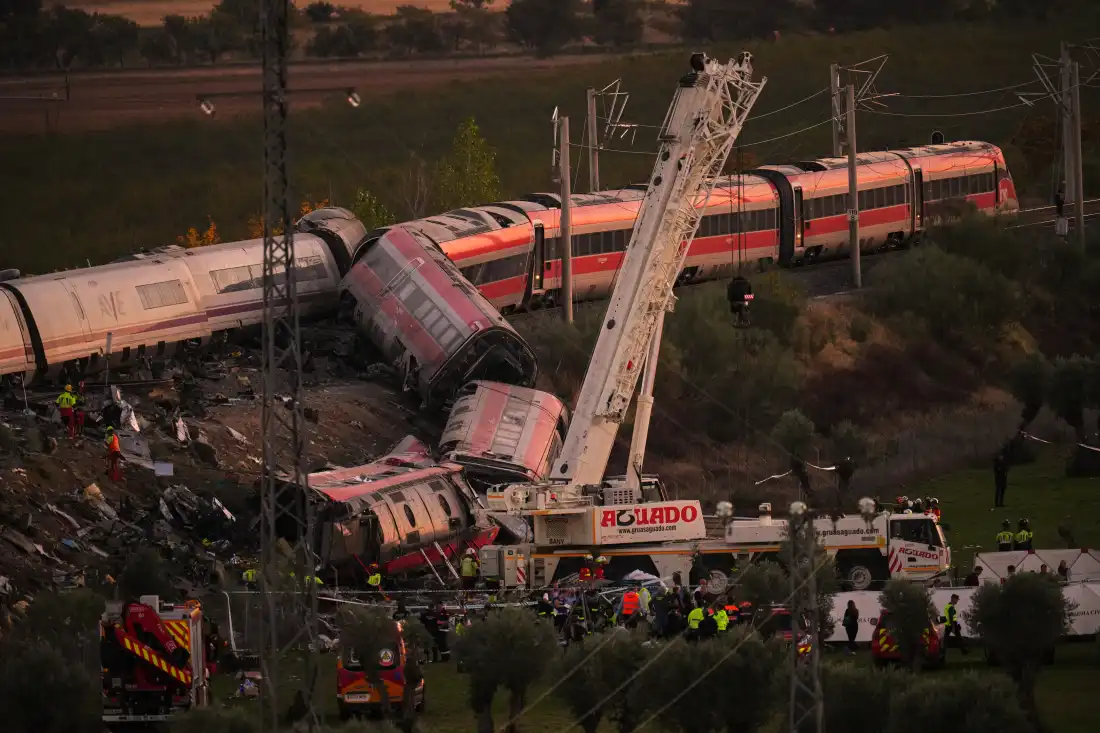
Renfe’s AVE 02080, the 08:00 from Madrid Atocha to Seville with 397 passengers, collided with Iryo service 6076, which had 147 people on board. Several carriages derailed and fell down an embankment. Iryo says its train was struck from behind at 08:48 near Urda, while other accounts give 08:53 and about 08:30.
The sources also place the site differently, from Los Yébenes and Urda to Mora and Orgaz, on the Madrid to Seville line.
The death toll rose through the day. The first reports spoke of at least 10 dead, then 30 and 31. Later figures reached at least 68, and 53 injured people remained in hospital. It is the deadliest Spanish high-speed accident since 2013, when 80 people died in Galicia.
Read also: The Law Has No Answer for a Trawler
The order under investigation
In the account reported so far, the train protection equipment at Urda suffered an IT outage at about 08:30, which stopped trains on the surrounding section. At 08:36 the control centre of the infrastructure manager Adif authorised the Renfe train to resume at line speed, even though the Iryo train was still stationary ahead.
Minister Óscar Puente called that decision “inexplicable” and said it was not a system fault. He said that under line-of-sight rules a limit of 40 km/h should normally have applied. The AVE then travelled about 25 kilometres before the collision, and its speed at impact is unconfirmed. Puente added that the Iryo train received a movement instruction after the AVE had started again, and that it is unclear why.
What Spanish media report
The broadcaster Cadena SER, citing government sources, said the Renfe train was allowed to proceed despite a stop indication. El País, also citing government sources, said an operator at the Atocha control centre may have authorised it by mistake.
An alternative signalling system was reportedly in use because of a problem with the main LZB protection system, and preliminary findings cited by Spanish media suggest several trains had stopped before operations switched to it. Investigators have not confirmed whether the reported instruction contributed to the collision.
Investigators are examining why the Iryo train stayed stopped, whether the Renfe driver was given permission to pass a red signal, what information controllers had, and whether the safeguards worked as intended.
What the operators and the state say
Iryo says the cause is unknown and that the circumstances are being investigated. Renfe activated its crisis team and a helpline for victims and relatives. Adif suspended traffic on the Madrid to Andalusia line and set up assistance points at stations along it. It has not publicly confirmed the alleged instruction.
Prime Minister Pedro Sánchez said decisive action would follow if negligence or failures are found.
Read also: European Governments Went Dark Over a PHP Flaw Whose Fix Stalled
The regional president of Castilla-La Mancha, Emiliano García-Page, said an independent railway accident commission should determine the cause and that “if there was any negligence, it will come to light.” The investigating body has not been named. CIAF, which led the Adamuz inquiry, is being replaced by a new multimodal authority.
Two accidents, two different failures
The Adamuz derailment in Córdoba province on 18 January had a different profile. The next day, an anonymous source said investigators had found a broken joint on the rails. Wear on the joint indicated the fault had existed for some time.
The Iryo train’s first carriages crossed the gap, and the last derailed and hit an oncoming train. Renfe’s president said human error was “practically ruled out”, and Puente said the track had been renovated the previous May.
No official cause for Adamuz has been published, and the investigation is still ongoing. García-Page says the causes of the two accidents appear unrelated. If the Toledo account holds, one accident involves a track defect and the other an operating decision, but both happened on infrastructure run by Adif. Toledo is the second fatal accident on the Madrid to Andalusia line this year.
The network, especially its high-speed lines, has reportedly suffered from a lack of investment in maintenance, and the largest train drivers’ union called a three-day nationwide strike after Adamuz, demanding more thorough safety checks.
SOURCES & METHOD
How this article was made. It rests on six sources. Puente’s account of the signalling order comes from Railway Gazette alone, and the controller-error reports reach us secondhand through IBTimes. No statement from Adif beyond service measures was available. Times and locations differ between sources, and the Adamuz finding was a preliminary account from one anonymous source in January.
Sources
- Railway Gazette: Investigation launched into second fatal accident on Madrid-Andalucía high-speed line this year (28 October 2026) – the trains, the timeline, Puente’s statements and the investigating bodies.
- IBTimes UK: Report claims Renfe AVE was cleared past red signal before hitting Iryo near Toledo (October 2026) – Cadena SER, El País and RTVE reports and the questions investigators are asking.
- Railway-News: Renfe and Iryo respond to fatal train collision in Toledo (28 October 2026) – the operators’ statements and Adif’s measures.
- ABC News: ‘Inexplicable’ order probed as cause of train crash that killed at least 68 (28 October 2026) – the toll, García-Page’s remarks and the 2013 comparison.
- The Irish Times: At least 68 killed after two high-speed trains collide in Spain (28 October 2026) – early toll, Sánchez and the Adamuz background.
- Reuters via Yahoo: Investigators find broken joint on track at Spanish rail crash site (19 January 2026) – the preliminary Adamuz finding.