



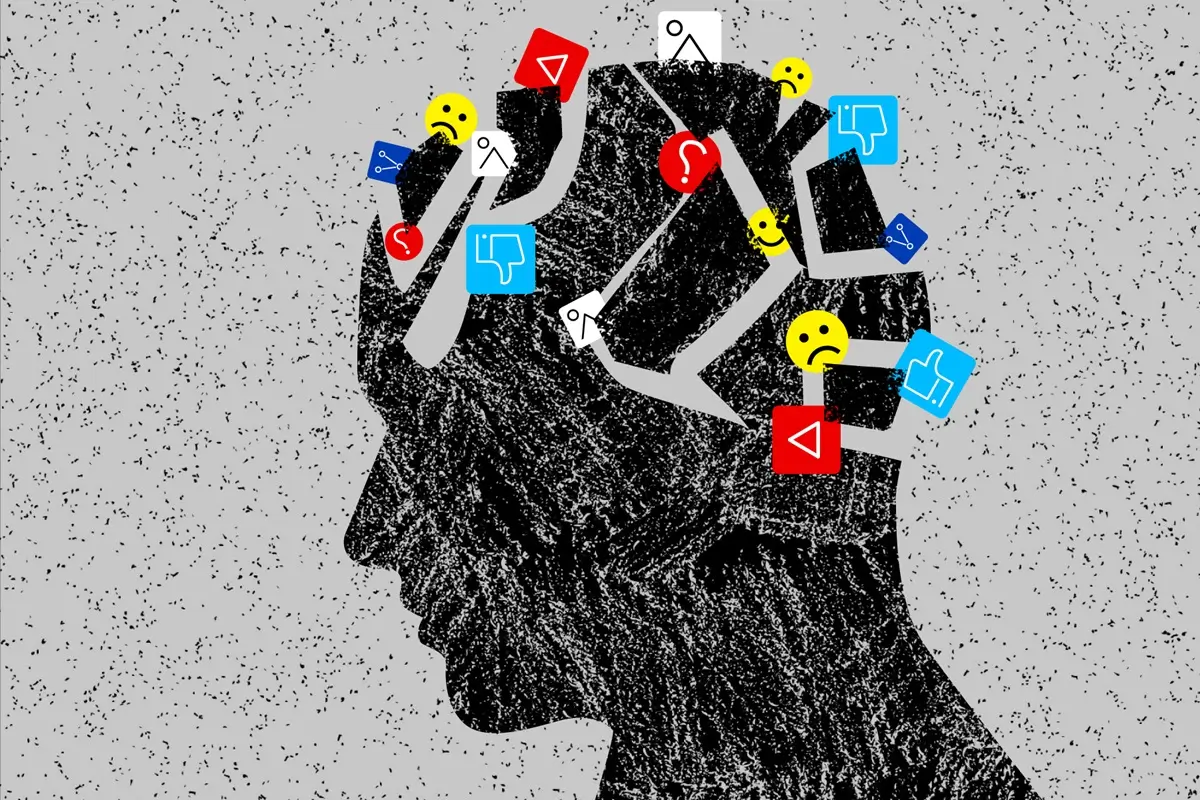
There is something odd about the way we talk about misinformation. The conversation always starts with concern, develops into indignation and almost always ends with a hidden message: other people fall for it. We do not. And that very self-satisfaction is exactly the vulnerability misinformation lives on.
I have followed this field closely for many years, and I have come to a realisation that is uncomfortable for anyone who calls themselves a critical thinker: Our brains are not built to navigate the information environment we live in today. It is not a new bug in the system. It is an old feature meeting a new world.
Deception is older than language
To understand why misinformation works, you have to go a long way back, not to election campaigns or social media, but to biology itself. Misinformation is not a modern invention. It is a communication strategy as old as life.
In nature, communication is never neutral. An anglerfish uses bioluminescence as bait in the dark deep sea: other fish, adapted to seek out light, swim straight into its jaws. Non-venomous snakes have evolved to imitate the venomous coral snake pattern precisely enough to escape predators.
Flowers send false mating signals to insects to secure pollination without giving anything in return. None of it is lying in a moral sense. It is evolutionary strategy. The sender’s goal is not truth, but influence.
The same principle applies to humans. If a signal is valuable, it creates an opening for a liar to exploit it. Misinformation looks like something we want to believe, because it is designed to bypass our filter, not confront it.
The savannah brain meets the smartphone
Our filter was shaped by an environment that stopped existing long ago.
We evolved in communities of about 150 people, where all information came from people we knew personally and had concrete reasons to trust or distrust. Our senses and instincts are fine-tuned to that environment: React quickly. Trust the group. Be sceptical of strangers. Prioritise survival over accuracy, because if you are too slow, you are dead.
Today we carry access to billions of strangers’ opinions in our pocket. If you compress all of humanity’s 300,000-year history into a single day, written language appeared only around 11 p.m. Gutenberg’s printing press arrived one minute to midnight.
Facebook, the iPhone and generative AI are the last five seconds. Biological evolution has not kept up. What for millennia was a life-saving ability: reacting quickly to threats, seeking patterns, trusting the group, is today the exact mechanism misinformation exploits.
Two systems, one vulnerability
The psychologist Daniel Kahneman’s classic model of the brain’s two modes of thinking is indispensable for understanding the problem. System 1 is fast, automatic and emotional: it costs no energy, runs on autopilot and relies on intuition and recognition.
System 2 is slow and analytical, but it takes effort and is in practice lazy: It only takes over if System 1 signals that something is unusual. Normally System 2 simply nods along to System 1’s conclusions and then finds rationales for why they were right.
Misinformation is designed to activate System 1 and keep System 2 passive. Rage, fear, contempt, moral outrage, promises of easy answers to hard questions: all of these emotional triggers put analytical thinking on pause.
When you are scrolling and something triggers a strong feeling, that is exactly the moment you are least equipped to judge whether it is true. It is no coincidence that this is the basic structure of the platform economy: Engagement is money, and nothing drives engagement like emotion.
Digital platforms such as Facebook, YouTube and TikTok are at their core advertising machines. Their algorithms are not programmed to promote truth. They are programmed to maximise the time you spend on the platform. False, provocative and fear-inducing content systematically performs better in these systems than nuanced, fact-based content, because it activates the emotional triggers faster and more strongly. In other words, the platforms are not passive channels for misinformation. They are active amplifiers of it.
The grammar of the tribe
If there is one element in the psychology of misinformation that is more dangerous than fear, it is belonging.
We are fundamentally tribal animals. For the vast majority of human history, exclusion from the group was a more immediate threat than many physical dangers. That feeling still sits in us, far deeper than our capacity for rational analysis.
It means that information is not just information. It is a loyalty test. When a claim hits our political, religious or social identity, we do not process it as a fact to be assessed. We process it as a signal of who we are and whom we side with.
This is where misinformation is at its most effective. A false claim that confirms your worldview is far easier to accept than a true claim that challenges it. And more importantly: Rejecting a false claim that your group shares feels like betrayal, not like critical thinking. Social media reinforces this by sorting people into echo chambers, where the only thing that varies is the intensity of the shared conviction.
Who produces misinformation, and why
The media and the public debate typically focus on the recipients of misinformation. That is understandable, but it is only half the picture. The other half is the structure behind production.
Misinformation is produced by widely different actors with widely different motives. The most basic is the commercial: Sensational false stories generate clicks, clicks generate advertising revenue, and that is enough for many content producers. Next is the political: Actors, parties, movements and lobby groups that use misleading information as a strategic weapon to shape public opinion.
And finally there is the state: Foreign powers that, with systematic and coordinated misinformation, try to undermine trust in democratic institutions, not because they want to promote a particular political view, but because chaos and distrust are themselves the goal.
It is no coincidence that all these actors converge on the same platforms and use the same algorithmic mechanisms. That is because the platforms have created an environment that consistently rewards content that triggers strong emotions, whether true or false. The platforms’ business model and the effectiveness of misinformation are not conflicting interests. They are two sides of the same coin.
Finland: A path that works
It is worth looking at what actually works, not as idealisation, but as structural comparison.
Also read: State money for the press: Who decides who survives?
Since 2016, Finland has integrated media literacy as a cross-disciplinary core competence across the entire national curriculum: from preschool to upper secondary school. It is not about a separate subject, but about a way of meeting all information: Who made this?
What is the source? What is the sender’s interest? It is a systematic and well-resourced effort, backed by state education policy. The result is that Finland consistently tops international indices for media literacy and resilience to disinformation.
The filter can be upgraded
The answer to misinformation is neither technological regulation alone nor naive faith that people will “just know better if they get enough facts.” Both underestimate the depth of the problem. It is about something more fundamental: an understanding that our brain is an evolutionary product adapted to a world that no longer exists.
The most important individual protection is, paradoxically, not knowing more. It is knowing when you are most vulnerable. Late in the evening, when you are tired. During intense news cycles, when everyone is worked up. When content triggers strong feelings that all point in one direction. Those moments are exactly the moments to slow down and ask: What does the sender want me to do with this? Who benefits from my believing it? And: Have I checked the source?
It is not a complicated exercise. But it is an exercise that requires you to accept an uncomfortable premise: That you yourself can be fooled. That your own filter can be hijacked. That misinformation is not something that only hits the uninformed.
It has to be said that we, society, the media, the educational institutions, have consistently misdiagnosed the problem. We have treated misinformation as an information problem that is solved with more information. But it is a trust and identity problem that requires something far more patient and relational: The ability to understand yourself as a recipient. The ability to ask when you are letting the tribe think for you.
Whoever sends out a false claim only needs to hit right once: the right moment, the right fear, the right identity string. The defence is not to become unaffectable. It is to know yourself well enough to notice when the filter is about to fail. It is not an academic exercise. It is a democratic necessity.
If you find this kind of structural analysis valuable, you are welcome to share the article with someone you disagree with, and watch for when that conversation suddenly becomes more about identity than about facts. You can support ExtraFokus’ independent journalism with a donation at extrafokus.eu. We continue to dig into the systems and mechanisms that shape the world we live in.
ExtraFokus.eu: A deeper look at the systems behind the news.