


If you cross an EU land border without papers and ask for asylum, an asylum emergency plan now being prepared in Brussels could let the country you reach refuse to register your claim. An unnamed EU diplomat told EUobserver that some 16 member states endorsed it at a breakfast before the summit on 16 October and want governments to be able to close borders and suspend asylum applications temporarily and selectively. What the plan would contain is unclear.
Table of contents
An asylum emergency plan without a text
Commission President Ursula von der Leyen announced a “European Emergency Response Framework to be triggered under defined criteria” in her State of the Union speech on 16 September, weeks after tens of thousands of people entered the Spanish enclave of Ceuta.
The Commission’s five-point plan of 29 September lists work on the framework, and interior ministers discussed it on 1 October without adopting conclusions. Asked whether it could suspend asylum at the external border, Commissioner Brunner answered: “I can’t go into details.”
The centre-right EPP, the party family of both von der Leyen and Brunner, adopted a resolution on 29 September calling for “legislative measures authorising refusal of entry” for people used in a hybrid attack. Poland’s deputy interior minister, Maciej Duszczyk, claimed credit for the plan, posting “Bravo Us!!” on X and writing that the instrument was modelled on Poland’s own suspension of asylum.
Read also: Europe’s New Migration Rules Turn Borders Into Waiting Rooms
480 refusals out of 621 claims
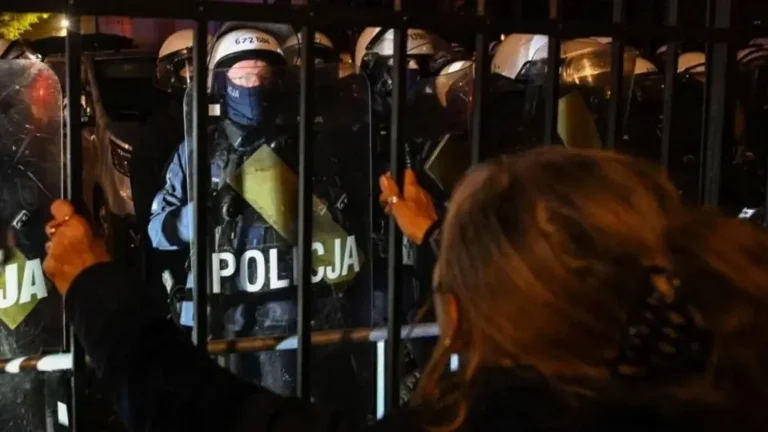
That suspension is the only working version. A Polish law of March 2025 lets the interior minister stop accepting asylum claims at the Belarus border for up to 60 days after finding that migration is being instrumentalised (steered by a hostile state to destabilise the country).
Parliament can renew the period at the government’s request, with no limit on renewals. The ban took effect on 27 March 2025 and was renewed for the seventh time in May 2026. Minors, pregnant women, people needing special healthcare and people at real risk of harm if returned are exempt.
Interior ministry figures show what that produced between 27 March 2025 and 19 May 2026: 621 people who crossed from Belarus sought asylum, 480 were rejected under the new law and 141 vulnerable people were accepted. In the month before the ban, 189 applications were accepted at the border.
A Białystok administrative court upheld a refusal for a Sudanese man in October 2025, in a ruling that could still be appealed at the time. Poland’s own human rights commissioner, Marcin Wiącek, wrote in May 2026 that what was presented as a “temporary” solution had by then been in place for over a year.
The Council of Europe’s commissioner, Michael O’Flaherty, wrote to Poland’s interior minister on 1 April 2026 that summary returns to Belarus without individual assessment risk violating the European Convention on Human Rights, which demands a “rigorous and individualised assessment” before removal.
He also said he understands that Poland’s remedies lack the automatic suspensive effect (a pause on removal while a court decides) that the Convention’s case law requires.
The crisis rules already bend, within limits
EU law already has an instrument for this. Regulation 2024/1359 defines instrumentalisation as a third country or hostile non-state actor encouraging the movement of people to the border “with the aim of destabilising the Union or a Member State”. A state in that position submits a reasoned request, the Commission has two weeks to decide, and the Council two weeks to adopt an implementing decision.
Read also: Brussels Prices Border Drones but Not Rights Monitors
Derogations last three months, can be extended once by three months, and total at most 12 months. Registration of a claim may be delayed up to four weeks after it is made, and measures may apply only to the extent “strictly required by the exigencies of the situation”.
Poland’s ban has run for more than 18 months and rests on Polish law. Von der Leyen has not specified which procedures the new framework would change, AP reported, and whether it would only delay registration, as the regulation does, or allow refusal outright, as in Poland, is open.
Backers without safeguards on paper
Poland is the reference point in the debate. The Commission’s January asylum strategy speaks of the “weaponisation of migration” by Belarus and Russia and links it to a December 2024 document arguing that the ban on pushbacks may not apply in exceptional situations, EUobserver reports.
So some 16 governments have backed a framework whose trigger, duration and rights safeguards remain unspecified. The one version that exists had rejected 480 of 621 claims by May 2026, and the Białystok ruling that upheld it could still be appealed when it was issued.
SOURCES & METHOD
How this article was made. The article rests on ten sources. Three are official: Regulation (EU) 2024/1359 on crisis and force majeure, the Council of Europe Commissioner for Human Rights’ letter to Poland’s interior minister and the EEAS page on the State of the Union 2026. Reporting comes from EUobserver (three pieces), the Associated Press (via WSB-TV) and Notes from Poland (two pieces), and ECRE, a refugee-rights network, supplies analysis of the emergency framework.
Sources
- EUR-Lex: Regulation (EU) 2024/1359 on crisis and force majeure (2024) – the definition of instrumentalisation, the derogation procedure, durations and limits.
- Council of Europe: Commissioner O’Flaherty’s letter to Poland’s interior minister (1 April 2026) – the human rights concerns about Poland’s asylum suspension.
- EEAS: State of the Union 2026, quotes and initiatives (16 September 2026) – the announcement of the emergency response framework.
- EUobserver: 16 EU states confirmed on board for plan to let countries close borders and freeze asylum (16 October 2026) – the endorsement at the pre-summit breakfast.
- EUobserver: EU’s centre-right EPP seeks asylum opt-outs as Commission silent on new crisis rules (29 September 2026) – the EPP resolution, Brunner’s answer and the January strategy.
- EUobserver: Poland’s pushback drive and EU asylum emergency plan put rights on a cliff edge (21 September 2026) – Duszczyk’s post claiming the plan is modelled on Poland’s suspension.
- AP via WSB-TV: Poland halted asylum claims at the Belarus border and now wants Europe to follow its example (September 2026) – the unspecified scope of the framework and the Polish suspension since March 2025.
- Notes from Poland: Human rights commissioner concerned that Poland’s temporary asylum ban still in place one year on (28 May 2026) – the Polish law, renewals, exemptions and interior ministry figures.
- Notes from Poland: Polish court rules asylum ban at Belarus border justified and lawful (10 October 2025) – the Białystok ruling, not final.
- ECRE: the EU emergency response framework (2026) – the dates of the speech, the five-point plan and the 1 October Council discussion.