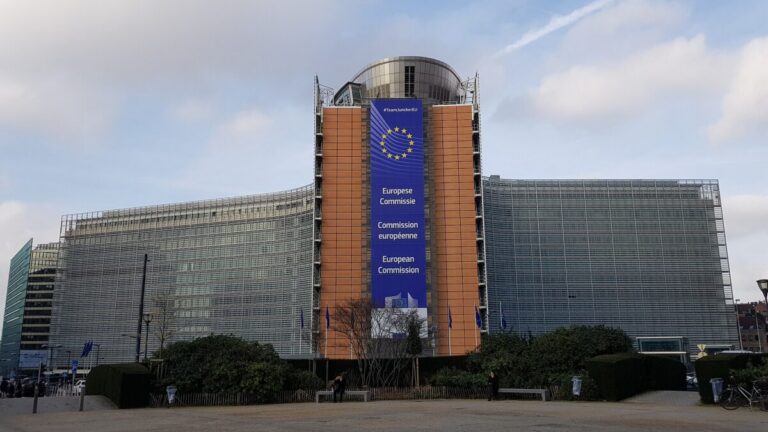



By March, Declan Rice, Virgil van Dijk and Morgan Rogers had already played more than 50 matches this season, according to FIFPRO’s monitoring. The calendar they play to is set by FIFA. Europe’s leagues complained about that to the European Commission in October 2024. The FIFA complaint has sat still since, and two years later there is still no case.
Table of contents
According to POLITICO, the complaint sits idle inside the Commission’s competition directorate. A senior EU official with knowledge of the file says it has been put in the freezer. Now a cross-party group of MEPs is pushing to get it moving.
FIFA writes the rules and sells the show
The complaint was lodged in October 2024 by European Leagues, FIFPRO Europe and Spain’s LaLiga. European Leagues speaks for 53 men’s and women’s professional leagues. It argues that FIFA abuses a dominant position by imposing its international match calendar on everyone else.
FIFA is both football’s top regulator and the organiser of its own tournaments. The complainants say that conflict of interest lets the federation profit from its own decisions. At the end of 2024 it held $4.76 billion in reserves, and the 2025 Club World Cup carried a $1 billion prize pool.
FIFA rejects the accusations. In 2024 it said its council approved the calendar unanimously after consultation. That unanimity covers FIFA’s own council. FIFA declined to comment on the complaint.
According to FIFPRO’s report from September 2025, the players’ union was not invited when FIFA, after a summer meeting with other player unions in New York, announced a consensus on player welfare, including a 21-day offseason and 72 hours between matches. The report also says no Club World Cup team gave players the four weeks off that researchers recommend.
Read also: Brussels Fined Big Tech 2.46 Billion. Washington Threatens Tariffs
Two skaters got a ruling. 53 leagues are still waiting
The Commission has taken on Google and Gazprom. FIFA is not on that list. Current and former officials point to sport’s special status in the EU treaties, but also to a deliberate choice to avoid emotionally charged cases.
A former senior official said that sports cases get political fast, and that member states tend to side with the federations. The Commission is therefore hesitant to pick the fight.
The skating case shows the directorate can act. On 8 December 2017 the Commission ruled that the International Skating Union’s rules broke competition law, after a two-year investigation of a complaint from two Dutch speed skaters, says Leiden University. The leagues’ complaint is just as old and has no formal case.
Then-competition chief Margrethe Vestager said the Commission was not going to referee every sports dispute, and that national courts and authorities are usually better placed. Those principles still decide which sports cases the directorate takes up. Competition lawyer Ben Van Rompuy of Leiden University advised the skaters. Now he expects little appetite in Brussels.
MEPs use FIFA’s sell-off plan as evidence
In a letter to Commission President Ursula von der Leyen, copied to competition chief Teresa Ribera, Bruno Gonçalves and Hannes Heide of the Socialists and Democrats and Bogdan Zdrojewski of the centre-right EPP asked for formal action, including on the European Leagues complaint.
They write that FIFA’s use of the calendar raises concern that it is wielding regulatory power for its own commercial gain. Such power must run through transparent, objective, non-discriminatory and proportionate procedures, as the EU’s top court required in its 2023 Super League ruling.
That ruling dealt with FIFA and UEFA blocking a new European competition. The court found their powers were not subject to such criteria, and that they were therefore abusing a dominant position. The Commission has yet to open a case testing those criteria on the calendar.
Read also: EU Leaders Want New Trade Tools Against China
“FIFA is both referee and promoter of the show,” Gonçalves said. The letter also points to a plan this summer, since dropped, to sell off parts of the World Cup to private investors. It says the plan exposed serious shortcomings in transparency, accountability and decision-making.
The national-courts argument has a hole
Two July rulings on FIFA’s agent rules went largely the federation’s way. The Court of Justice accepted that federations may impose restrictions if they pursue legitimate aims proportionately.
Van Rompuy points out that courts have since given plenty of guidance, and that national enforcement seems to work. The leagues have themselves sued FIFA in a Brussels court, which he reads as a sign they believe in it. Against the Commission’s prioritisation criteria the case looks weak, he says, because its effect on the internal market is very limited.
The argument has a hole, because the calendar is one for the whole world, and a national lawsuit can test part of it but cannot rewrite it. The criterion measures the market, not how many matches a player can take.
Commission spokesperson Ricardo Cardoso says sport is mainly for national governments, with the EU in a supporting role. When sports bodies engage in economic activity, competition rules apply, he says, and any complaint gets assessed under standard practice.
After two years the complaint is still not a case.
FIFA still sets the calendar by itself.
SOURCES & METHOD
How this article was made. The article rests on nine sources. None is a Commission or FIFA document: the complaint is described through the filers’ own statement (LaLiga), the players’ union FIFPRO and reporting by POLITICO Europe, Euronews, Reuters (via The Star and The Sun Malaysia), Front Office Sports and Inside World Football. Leiden University is used for an academic assessment.
Sources
- POLITICO Europe: Why the EU avoids tackling Big Soccer (22 Oct 2026) – the stalled complaint, the MEP letter, the Commission’s and officials’ positions, Van Rompuy’s assessment.
- LaLiga: Football player unions and leagues file complaint to European Commission over FIFA’s imposition of the international match calendar (14 Oct 2024) – the original complaint and who filed it.
- Euronews: EU top court finds FIFA, UEFA abused dominant position in Super League case (21 Dec 2023) – the 2023 ruling behind the test the MEPs cite.
- Leiden University: Ben Van Rompuy comments on victory in the EU antitrust case against the International Skating Union (Dec 2017) – the 8 December 2017 decision after a two-year investigation, and Van Rompuy’s role.
- Front Office Sports: Global soccer union says players need more rest time (FIFPRO workload report, Sep 2025) – rest-period findings and FIFA’s welfare announcement without FIFPRO.
- FIFPRO: Player workload in sharp focus at International Sports Convention in London (26 Mar 2026) – match counts for Rice, van Dijk and Rogers.
- Inside World Football: FIFA reports budget revision for the 2023-26 cycle (16 May 2025) – FIFA’s reserves at the end of 2024.
- Reuters (via The Star): European Leagues tackles FIFA over women’s match calendar in expanded EU complaint (8 Sep 2026) – the widened complaint.
- Reuters (via The Sun Malaysia): European leagues and union appeal to EU against FIFA over crowded calendar (2024) – FIFA’s position that its council approved the calendar unanimously.