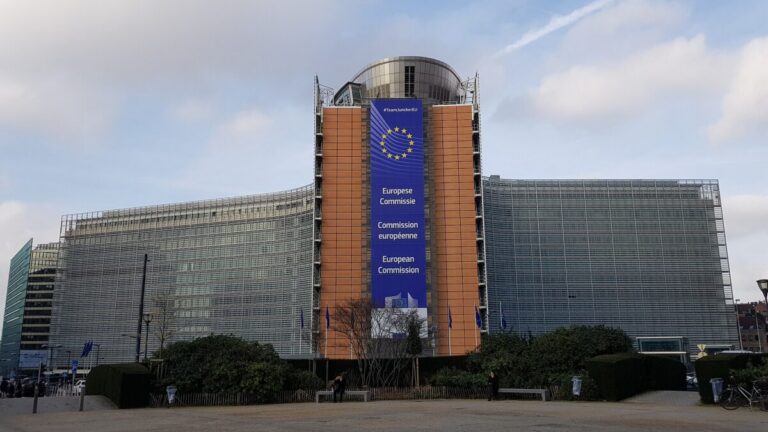




The rules that decide which weedkillers and insecticides stay on the EU market are being rewritten, and the Commission chose not to run a full impact assessment first. Its proposal would make pesticide approvals for active substances (the chemicals that do the killing) unlimited in time, so that a substance approved once no longer returns for routine review.
Table of contents
Anyone who eats EU-grown food or lives next to a sprayed field is affected.
Pesticide approvals with no expiry date
Pesticide approvals in the EU currently run for fixed periods, commonly 10 to 15 years, after which the substance is reassessed. The Commission’s food and feed safety omnibus, proposed in December 2025, changes that. Its explanatory memorandum says approvals of active substances “become unlimited in duration”.
Exceptions remain for substances flagged for substitution and for those approved under the derogation for a serious danger to plant health. The proposal also lets the Commission identify some unlimited approvals for a full renewal procedure.
Five UN human rights experts wrote to the EU on 7 October. They cite an assessment commissioned by the Dutch Parliament, which says that “the burden of proof will be shifted from substance producers to governments”, and they say 49 substances, among them glyphosate and acetamiprid, would reportedly benefit from open-ended approval.
The French NGO Générations futures puts the same figure at 49 of the 421 synthetic active substances now approved.
Read also: Europe’s Farm Money Flows Uphill
Three years to sell what was withdrawn
When a substance is withdrawn, existing stocks can still be sold and used for a limited time. The memorandum describes today’s limit as 6 months for sale and distribution plus a further year for existing stocks.
The Commission proposes this: “Doubling the maximum overall length of grace periods to 3 years”. The memorandum justifies the longer period where reasonable alternatives do not currently exist, and the proposed text keeps an exception for immediate and serious concerns for human or animal health or the environment.
The UN experts say the plan to extend grace periods, widen derogations and limit the use of the latest independent evidence is “difficult to reconcile with the precautionary principle”, according to EUobserver. The experts also cite the rights to health, food and a safe environment, including those of rural workers.
The assessment that would add no value
The memorandum explains why there is no full impact assessment: “a full impact assessment would not bring added value”. An analytical staff working document accompanies the proposal instead. The same memorandum estimates business cost savings of €335.6 million a year from 2027 and public administrative savings of €661 million a year.
The UN experts ask whether a comprehensive impact assessment covering health, environmental and distributional effects has been or will be carried out. Their concerns are directed at the Commission, Parliament and Council.
Read also: Commission Cannot Cost the EU Kids Act
500 scientists ask for a pause
On 16 September more than 500 scientists and doctors signed an open letter to Parliament President Roberta Metsola and the chairs of the environment and agriculture committees.
They ask Parliament to suspend work on the omnibus until an independent impact assessment is complete. The initiator, Leiden ecotoxicologist Martina Vijver, said: “We are already finding traces of pesticides everywhere”. She added: “We are not advocating a particular political outcome.”
A vote without a date
Parliament’s environment and agriculture committees were due to vote jointly on a compromise text on 5 October. The vote was shelved, and as of 14 October no new date had been set, EUobserver reports. The co-rapporteurs are Herbert Dorfmann (EPP) and Michele Picaro (ECR). Their proposals include, according to ARC2020, a grace period of two years for withdrawn substances.
The Commission has put a figure on what the change saves business and administrations. What open-ended approvals could cost in health and environmental harm rests on a staff working document and the Commission’s view that a full assessment adds no value.
SOURCES & METHOD
How this article was made. The article rests on seven sources. Two are official: the Commission’s proposal COM(2025) 1030 on EUR-Lex and a communication from UN Special Procedures. Scientists’ criticism comes from a Leiden University page about an open letter. Campaign and trade reporting comes from ARC2020, PAN Europe, EUobserver and Global Agriculture.
Sources
- European Commission: Proposal for a Regulation on food and feed safety simplification, COM(2025) 1030 (December 2025) – the proposed unlimited approvals, longer grace periods, waived full impact assessment and savings estimates.
- UN Special Procedures: Communication OL OTH 85/2026 (7 October 2026) – the concerns of five UN human rights experts on the omnibus and their questions to the EU.
- Leiden University: European scientists sign open letter on relaxation of pesticide regulations (16 September 2026) – the scientists’ call to suspend Parliament’s work pending an independent impact assessment.
- EUobserver: MEPs pause vote on EU pesticides bill (14 October 2026) – the shelved committee vote and the UN experts’ letter.
- ARC2020: Simplification Sandwich, what’s inside the Food and Feed Omnibus (17 July 2026) – the content of the package and the co-rapporteurs’ proposals.
- Global Agriculture: EU Parliament stalls on pesticide approval overhaul (12 October 2026) – current approval periods and the Générations futures estimate of affected substances.
- PAN Europe: Food and Feed Safety Omnibus, weaker protection – an advocacy group’s reading of the proposal, including the 49-substance estimate.