
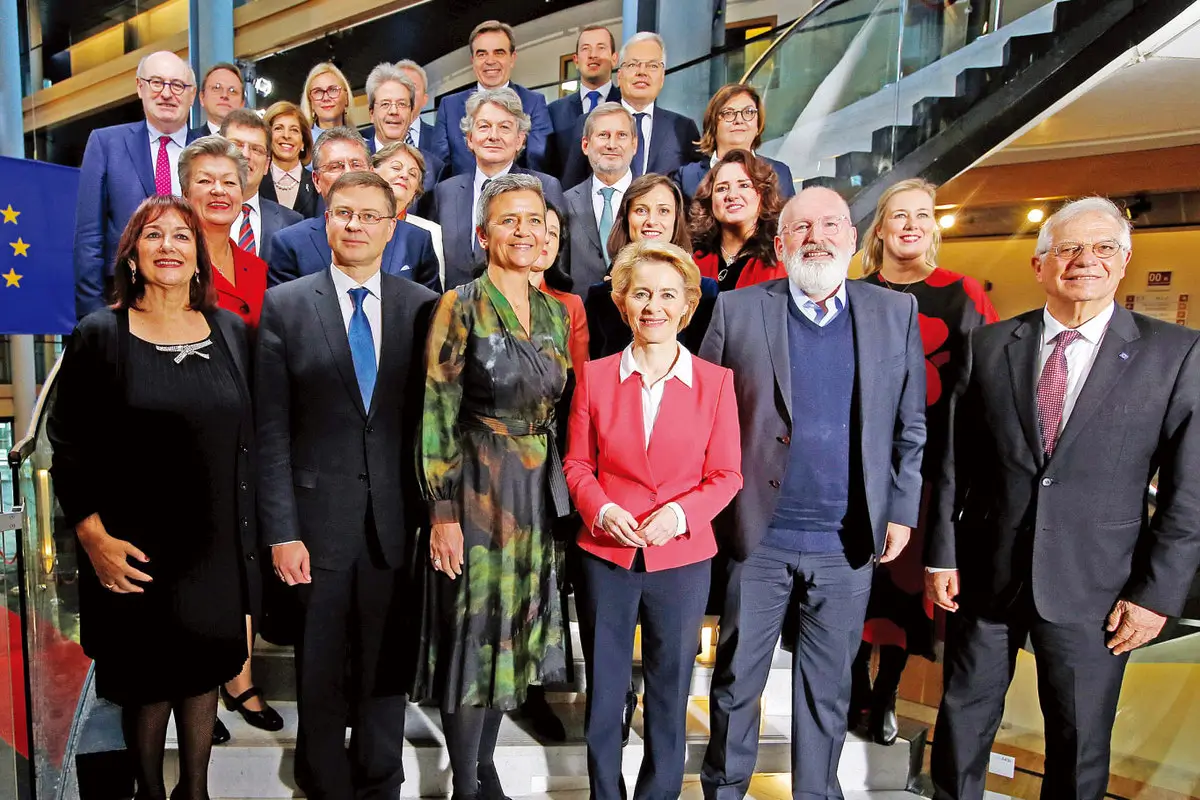
Ask who runs the European Union and you get three answers. The Commission says it proposes the laws. The governments in the Council say they decide. The Parliament says it is the only body voters elect. A fourth answer sits in the lobbying register: since December 2024 the Commission has logged more meetings with outside interest groups than it did in its entire previous term.
Table of contents
All four answers are partly true.
The formal map: three institutions and two referees
The European Commission has 27 members, one per country. It holds the right to propose legislation in most policy areas, and it acts as guardian of the treaties, which means it can take governments to court. The Parliament and Council can formally ask the Commission to act, but in practice the Commission still controls the agenda and the technical detail of most texts.
The Council of the EU is the governments. Ministers meet in different configurations by subject. Most decisions need a qualified majority, meaning at least 55 percent of member states representing at least 65 percent of the EU population. Sensitive areas such as tax and foreign policy still require unanimity.
Read also: Brussels Fined Big Tech 2.46 Billion. Washington Threatens Tariffs
The European Parliament has 720 members elected every five years. Since the Lisbon Treaty in 2009 it stands roughly equal to the Council on most legislation, and it must consent to the budget and to major agreements such as trade deals. It cannot propose a law itself.
The European Council is the heads of state and government. It passes no laws. It sets priorities and settles quarrels that ministers cannot, from the euro crisis to sanctions on Russia.
Where the text is really settled
The formal votes are the end of the process. Before them, the Parliament, the Council and the Commission meet in closed negotiations called trilogues and agree a text that the full bodies then approve. Beneath the Council sit working groups of national civil servants who grind through the detail months before a minister sees a paper.
A third layer deserves more attention than it gets. After a law passes, the Commission often adds the technical rules through implementing and delegated acts, which do not go through the ordinary legislative procedure.
The fight over the EU digital identity wallet is a live example. The digital rights group EDRi argues that the Commission is weakening privacy safeguards in the implementing acts that the Parliament never voted on in that form. You can disagree with EDRi. The route it describes is real.
17,000 organisations and a diary
The EU’s Transparency Register, shared by the Parliament, the Commission and the Council since 2021, listed 17,269 organisations from 140 countries when Transparency International EU analysed it in spring 2026. That is up from close to 12,500 in February 2024, and 4,112 organisations joined in 2025 alone.
Read also: Commission Cannot Cost the EU Kids Act
Transparency International EU’s analysis of the data offers these figures:
- Companies, business groups and trade associations make up 47 percent of registrants. NGOs make up 27 percent.
- The Commission logged 27,523 meetings with interest groups from December 2024 to April 2026, more than in the whole 2019 to 2024 mandate.
- The top 500 organisations account for 47 percent of those meetings. NGOs took part in 16 percent of them.
- Among the 100 organisations with the most Commission access, 84 represent corporate interests.
- Parliament members logged 63,518 meetings from June 2024, against 64,151 in the entire previous term.
A caution applies. Logged meetings measure what is disclosed. A rise can reflect better compliance with disclosure rules as well as more lobbying. What the numbers do show is who gets into the diaries of decision makers, and corporate interests dominate.
The rules also differ by institution. Commission officials at high level may only meet registered lobbyists. Transparency International EU says the same requirement does not apply to the Parliament, and it calls the Council, where member state governments negotiate, the EU’s most opaque institution.
Who checks the people with the power
The Qatargate corruption scandal of December 2022 forced the question. In early 2023 the Parliament demanded an independent ethics body with powers to investigate, a mandatory register for all events involving lobbyists, and cooling-off periods for former MEPs.
What came out is a smaller thing. On 15 May 2024 eight institutions signed an agreement creating an ethics body that develops common minimum standards on interests, outside activities and gifts, and publishes an annual report. It does not investigate individual cases or recommend sanctions.
The European Council does not take part. In the Council, member states declared that the treaties give no legal basis for common ethics rules for their government representatives, so those representatives fall outside the standards. Transparency International EU said the body lacks the powers to close existing loopholes.
Revolving doors remain a gap. Transparency International EU found that sitting MEPs declared 1,678 outside activities, more than two per member, and it wants cooling-off periods of up to 36 months for outgoing commissioners. The 2022 Uber Files case of former commissioner Neelie Kroes is the standard example: she lobbied Dutch officials for Uber in 2015 and 2016, after leaving the Commission and while barred from working for the company by the cooling-off rules.
Elsewhere in Europe: national rules are often stricter than Brussels
The EU institutions are not alone in struggling with this, and several member states went further on lobbying transparency than the EU itself.
A comparative table from the French transparency authority HATVP lists lobbying registers with sanctions in Austria (law of 2013), France (2016), Germany (2021), Ireland (2015, with later amendments), Lithuania and Slovenia. The United Kingdom has a register for consultant lobbyists from 2014. Denmark does not appear in that table.
Two questions to ask about any EU decision
Ask who drafted it: which Commission department proposed it, who sat in the trilogue and which working group prepared the Council position. Then ask whose names are in the diaries of those officials in the months before.
EU politics is hard to follow without patience, and that difficulty is useful to anyone who wants a law to pass without noticing.
BASIS OF ANALYSIS
Basis of analysis. The analysis rests on nine sources. Two are official or institutional: the European Parliament Think Tank briefing on lobbyists and the comparative lobbying table of HATVP, the French transparency authority. Transparency International EU supplies the lobbying data (two pieces), eucrim reports on EU ethics bodies (two pieces), and EDRi and DutchNews cover the eID wallet and the Neelie Kroes ethics case. One source is ExtraFokus’s own earlier Danish article.
Sources
- Transparency International EU: Who really has the EU’s ear (29 May 2026) – register size, meeting counts and corporate share.
- Transparency International EU: EU political integrity – side activities, revolving door, the Council as a black box.
- eucrim: New ethics body set up to develop a common ethics culture in EU institutions – the 15 May 2024 agreement and its limits.
- eucrim: EP pushes for increased transparency and integrity after Qatargate (10 March 2023) – what Parliament demanded in February 2023.
- European Parliament Think Tank: Lobbyists and interest representatives – how the shared register works.
- HATVP: International comparative lobbying table (2023) – national lobbying registers and the years of their laws.
- EDRi: The eID wallet still doesn’t deserve your full trust (10 March 2026) – the implementing-acts dispute.
- DutchNews: Former commissioner Neelie Kroes breached ethics rules by lobbying for Uber (July 2022) – the Uber Files case and the cooling-off period. \n
- ExtraFokus (Danish): Sadan fungerer EU’s magtstruktur – the original explainer this piece updates.