


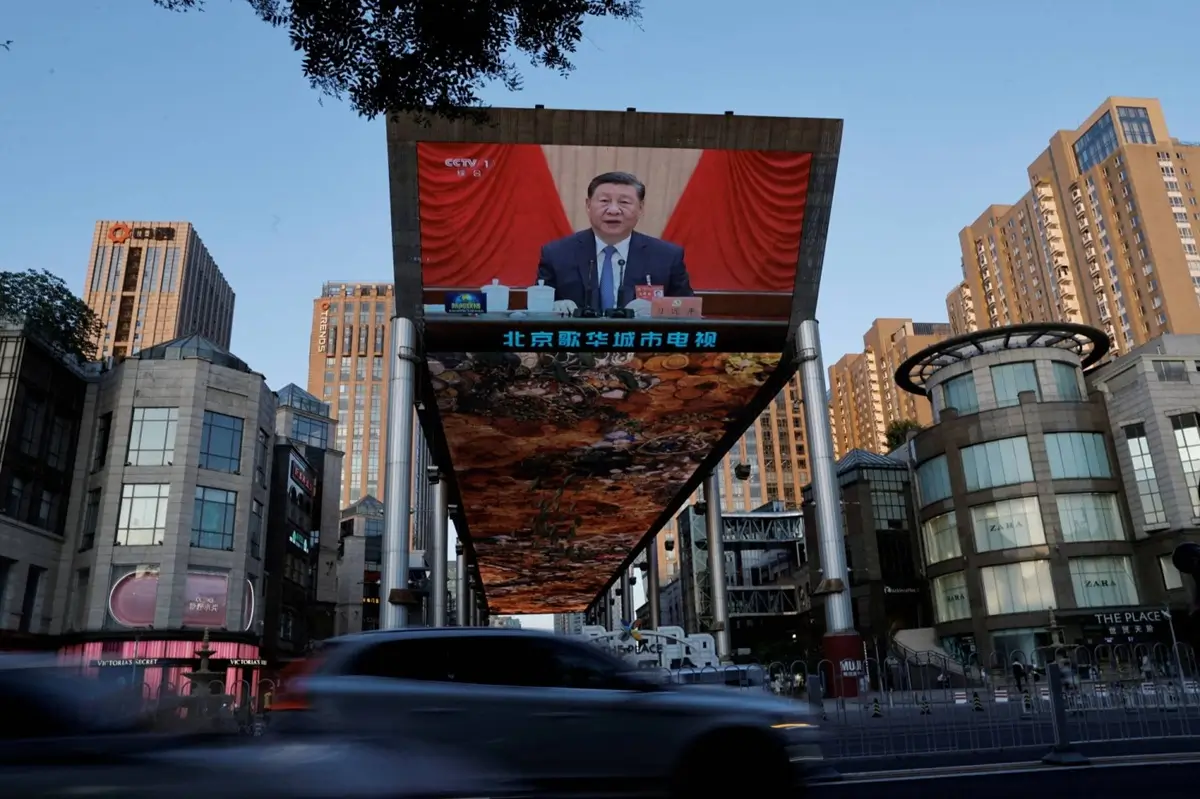
I keep reading European plans for dealing with China, and they share one habit: they treat Beijing as a counterpart that is stable, consolidated and able to keep its word. On 26 October, with Xi’s purges still reshaping the party, the Communist Party’s Central Committee began four days of closed-door talks, and the stated subject is party discipline. That agenda tells us more about the counterpart than any trade communiqué.
Table of contents
Xi’s purges reach his own committee
Xi Jinping has cautioned against “two-faced people” who profess loyalty while defying orders. Analysis by Neil Thomas and colleagues shows that 42 of the 44 military-affiliated full Central Committee members elected in 2022 have been purged or have disappeared. The same analysis estimates that attendance at the plenum could fall below 80 percent, possibly a record low since 1976.
The meeting will formalise the largest reshuffle of senior officials on record. The committee has 205 full members, about two-thirds will reach mandatory retirement age by the congress in October 2027, and 20 full and 7 alternate members are under corruption investigation and expected to be expelled.
Last year’s plenum expelled nine more officers, among them Miao Hua, who ran the military’s political work department. Tai Ming Cheung, who directs the University of California Institute on Global Conflict and Cooperation, writes that the campaign has led to the arrest of several dozen top generals and defence industry heads since 2023. He reads the pattern as a sign of low leadership trust in the armed forces.
The charges tell the same story. The army’s own newspaper accused the nine officers of economic crimes, but focused mainly on political and ideological offences, including disloyalty to the party.
Read also: Europe's Rare Earth Deal With China Is a Favour Beijing Can Withdraw
What Europe’s toolbox assumes
Brussels has built a vocabulary around Beijing: dialogue, de-risking, trade defence. Each term assumes someone on the other side who can trade a concession for a concession and stand behind it. The record from this autumn is thinner. The China think tank MERICS notes that Europe had little say when Washington and Beijing negotiated in October, while export controls on rare earths, gallium and semiconductors still hit European industry.
The Nexperia dispute led Bosch to cut production at three plants. New Chinese procurement standards in 2026 give domestic products a 20 percent advantage in public tenders, which puts European suppliers at a disadvantage in a market worth CNY 3.38 trillion in 2024. These are the facts a negotiator carries into the room.
The same MERICS assessment expects Beijing to become less willing to compromise and more nationalistic. It also warns that the purges could push mid-level officers to prove their loyalty through riskier, more proactive behaviour. I read that as the core problem. In a system that measures officials on loyalty, the safe career move is the harder line.
The strong leader argument
The counterargument is easy to state. Xi is widely expected to secure a fourth term in 2027, and Steve Tsang expects any new appointees to be loyalists. A leader that secure can sign deals, and MERICS considers wider unrest unlikely given the state’s control capabilities.
That holds at the top and says little about the floors below. Punishments for formalism and bureaucratism, such as inaction and dereliction of duty, have risen sharply in recent years. An official facing that risk has every reason to avoid being the person who made the concession. European negotiators will deal with exactly those officials.
Read also: EU Leaders Want New Trade Tools Against China
Plan for the Beijing that exists
Europe should keep talking to China, and the toolbox needs an honest premise. Agreements with a leadership that is removing its own generals and committee members will be only as durable as the next loyalty campaign, and Brussels should price that in before it writes the next dialogue into a joint statement.
That means planning for export controls that stay in place and for counterparts who cannot afford to concede. It is a harder position to sell at home than a summit photograph, and a safer one to negotiate from.
If Xi’s own party cannot keep 42 of 44 military-linked committee members in place, Brussels has little reason to assume its signature will hold. Europe is betting on trust in a system that spends its energy removing it.
Sources
- Korea Times: What to know about China’s plenum as Xi seeks stronger party discipline (26 October 2026) – the opening of the plenum, Xi’s warning, the 42 of 44 figure and the analysts quoted.
- Seoul Economic Daily: China’s Communist Party set for biggest leadership shake-up (25 October 2026) – committee size, expected expulsions and the reshuffle as reported by the South China Morning Post.
- UC Institute on Global Conflict and Cooperation: Continuity and a military purge at China’s fourth plenum – the 2025 expulsions and Tai Ming Cheung’s reading.
- MERICS: Top China risks 2026 – trade controls, the Nexperia dispute, procurement rules and the assessment of Beijing’s posture.
- Reuters via Internazionale: Xi chairs Politburo, plenum set for October 26-29 (21 September 2026) – the plenum dates and its stated focus on party self-governance.