



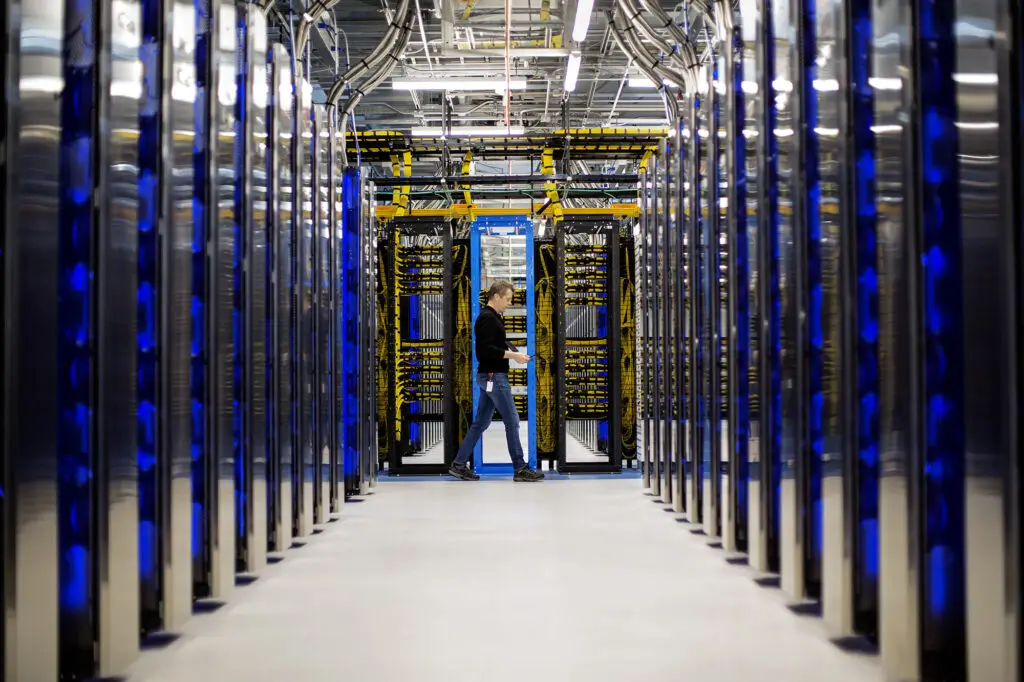
Fouju, a village of about 600 people in Seine-et-Marne, is the planned site of what its backers call the largest data centre project underway in Europe: eleven buildings on 90 hectares, drawing 1.4 gigawatts at full capacity. The budget is €50 billion. A petition against it had nearly 70,000 signatures by late September, and the question behind it is the one residents ask in many other places: who decides?
Table of contents
The fight has a mirror image across the Atlantic. Public opposition in the United States has produced ballot initiatives to ban data centres and has pushed candidates to change their platforms. Europe has the same ingredients, water, power and land, and a different referee.
Two French villages show the pattern
The Fouju campus is backed by MGX, Bpifrance, Mistral AI and Nvidia. Opponents plan two legal challenges, one against a change to local planning rules and one against the environmental study. The petition names water pollution among its concerns.
In Indre, Google plans a site of about 195 hectares with eight to ten buildings at Étrechet, near Châteauroux. Three deputy mayors and a councillor resigned on 10 September, and the mayor followed on 15 September. Deputy mayor Marie-Pierre Chabenat-Canals cited visual impact, water resources and strain on the grid.
A local petition had almost 20,000 signatures by late September. The mayor of Châteauroux, Gil Avérous, calls the project a historic opportunity and says it will create nearly 1,000 direct and indirect jobs.
Read also: Europe Writes AI Rules for Systems It Rents
Paris wants it, and can override the town
Junior minister Anne Le Hénanff calls building data centres on French soil a priority that serves digital sovereignty. Macron reportedly added Étrechet to a list of 150 strategic industrial projects in April, before Google confirmed the site.
Projects of major national interest, such as Fouju, can use a fast-track procedure that lets the state override some local planning rules. Each project still needs a grid connection from the operator RTE, planning permission and usually an environmental authorisation from the local prefecture, and each decision can be challenged in court. Court challenges can take a year or more.
The grid is where the scale shows. About 80 data centre projects are seeking connections, and RTE had reserved close to 18 GW by May 2026, up from around 40 projects and 5 GW at the end of 2024. Roughly three quarters are colocation centres that rent space and power to several companies, and a reservation does not guarantee that a project gets built.
France’s roughly 300 existing data centres use about 10 TWh a year, about 2 percent of national consumption. RTE forecasts 23 to 28 TWh by 2035, about 4 percent.
The pipeline reaches well beyond Fouju. SoftBank plans up to €75 billion for 5 GW, with a first phase of €45 billion across three sites in Hauts-de-France, at Loon-Plage, Bosquel and Bouchain, due by 2031. Data4 plans a 1 GW site at a former airbase in Cambrai and a €5 billion, 700 MW campus in Escaudain.
The American mirror
The US debate runs on the same grievances. More than 1,500 new data centres have been proposed there, and a Gallup poll earlier this year found about seven in ten Americans opposed to building them in their area. A Reuters/Ipsos poll in June found 59 percent opposed to one within 10 miles of their home. The concerns are utility bills, water use, land use and proximity to homes, and residents want more input.
The issue crosses party lines. Texas Senate candidate James Talarico, a Democrat, wants to rein in the companies over utility bills and water use. Florida gubernatorial candidate Byron Donalds, a Republican, says water use can be managed and that sites should be kept away from residential areas. President Trump urges communities to accept data centres. New York has imposed a one-year statewide moratorium.
The difference is the instrument. American voters can reach for ballots and moratoria. European residents mostly meet planning files, court deadlines and, from 2027, a label.
Brussels measures data centres and sets no cap
The European Commission wants to triple EU data centre capacity over the next five to seven years. The path runs from 12 GW last year to 28 GW by 2030, and data centres use about 2.5 percent of EU electricity today. The Commission cites the International Energy Agency (IEA), which projects more than 3 percent of EU electricity demand by 2030.
On 21 September the Commission proposed a common rating scheme for data centres above 500 kW. Operators would give transparent information about their actual use of energy and water, and about their contribution to the grid through waste heat reuse and flexibility. Operators would also show how their water use relates to local water stress.
The proposal puts no cap on energy or water use and does not require operators to disclose total power use. Parliament and Council have two months to object, and the first labels are expected in 2027. The label could lead to mandatory minimum standards, which the EU is still developing, and a public consultation on them is open.
Ireland and the Netherlands found other brakes
Ireland shows what a hard limit looks like. Campaigners and grid-strain warnings led to a freeze on new data centre connections around Dublin, expected to last until at least 2028. The regulator’s decision of December 2025 goes further for new sites: those of 10 MVA and above must provide dispatchable generation or storage covering 100 percent of their maximum import capacity.
Data centres above the minimum threshold must also meet at least 80 percent of annual demand from renewable electricity generated in Ireland within six years, and the grid operators may refuse a connection in constrained areas, according to the law firm A&L Goodbody.
Ireland’s Large Energy-User Action Plan of January 2026 sets 17 actions over five years to pair energy-intensive demand with renewable capacity. It expects large users to support the system, for example through flexible connections and on-site storage, and commits to legislating for private wires in 2026.
In the Netherlands, Amsterdam paused new sites and later restricted them to designated areas. Farmers who cited environmental damage and nitrogen-permit impacts helped derail Meta’s Zeewolde campus. Tech firms projected thousands of jobs in Romania and the Netherlands, but only about a quarter have materialised.
In Spain, activist Aurora Gómez of the collective Tu Nube Seca Mi Río says mayors learned of projects only after regional deals were final and announced in the press. Companies often deal directly with regional or national governments, bypassing local consultation, and incentives usually come from public budgets.
Read also: Britain's AI Champion Builds in West Virginia
The case for building anyway
The arguments for new capacity are real. The EU wants to triple capacity partly to reduce reliance on US Big Tech. The Commission says reusing about half of the waste heat from EU data centres would meet the heating demand of four million households, and in Helsinki server heat already feeds the district heating network.
Those arguments describe benefits and leave open who carries the costs. The jobs forecasts in the Netherlands and Romania suggest that local gains can fall short. And the timing favours the builders: the first labels arrive in 2027, minimum standards are still in consultation, and SoftBank’s first phase in northern France is due by 2031. Permits for those sites may well be decided before any minimum standard exists.
What residents can use today
The tools are zoning and land-use checks, environmental impact assessments, grid connection requests, water-use licences and subsidy agreements, all requestable, including through freedom of information requests. In Spain, journalists uncovered the full scale of Amazon Web Services’ water and power use only by examining planning and licensing files.
In Germany, expert reviews in Frankfurt challenged the claimed benefits of large data centre clusters, and BUND regional groups oppose projects in Hesse and the Rhineland. The Energy Efficiency Act requires new centres to source 100 percent renewable electricity from 2027, with compliance calculated on an annual basis.
A label tells a village of 600 what a campus will consume, and the proposal sets no cap on it.
BASIS OF ANALYSIS
Basis of analysis. The analysis rests on 7 sources. The Commission’s announcement is the only primary document; the rest are news reports, a campaign guide, a law firm’s summary of an Irish regulatory decision and an S&P Global summary. The full text of the Commission’s legal proposal was not available, and no figure for the water use of the French campuses could be confirmed.
Sources
- European Commission: Making data centres energy efficient thanks to new EU rating system (21 September 2026) – scope, 500 kW threshold, timeline and the capacity goal.
- Reuters via The Star: EU to require data centres to disclose energy and water efficiency (21 September 2026) – what operators must disclose, absence of caps, capacity and consumption figures.
- The Local France: Opposition grows as France plans wave of giant data centres (1 October 2026) – Fouju, Étrechet, grid reservations and the fast-track procedure.
- AlgorithmWatch: How to resist data centers, a guide for local communities in Europe – cases in Ireland, the Netherlands, Spain and Germany, and the tools residents have.
- A&L Goodbody: Data centres and the grid, how recent Irish policy will shape the sector – the Irish regulator’s December 2025 connection requirements and the January 2026 action plan.
- S&P Global Market Intelligence: Data center backlash shapes midterm ballots, campaigns across US (1 October 2026) – the US ballot initiatives and campaign effects.
- Data centers emerge as bipartisan flashpoint ahead of 2026 midterm elections (syndicated news report) – US polls, candidates’ positions and the New York moratorium.