



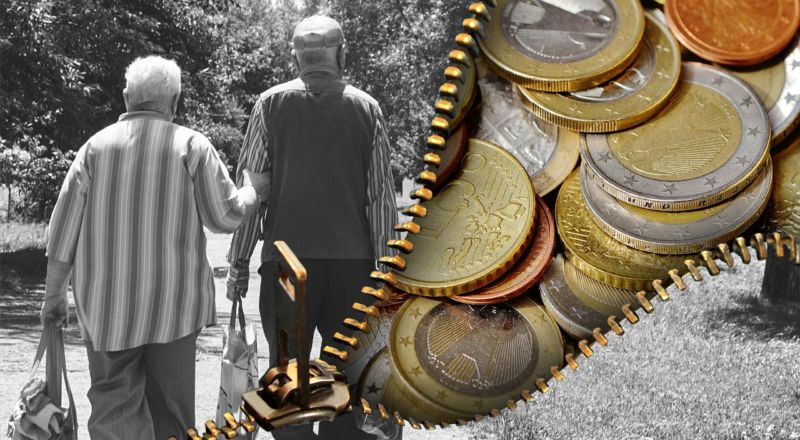
The European Commission has already told Europe’s workers what their pensions will look like. The 2024 Pension Adequacy Report states that replacement rates, the share of final pay that a pension replaces, “are set to fall for both women and men in most countries”. The finding rarely reaches a campaign speech, because it points to a fight between generations that no party has agreed to have.
Table of contents
A flat budget for a growing group
The Commission’s 2024 Ageing Report projects that public pension spending across the Union will be 11.4 per cent of GDP in 2022 and 11.8 per cent in 2070. That is almost a flat line. On its face it sounds like reassurance.
Now add the other half of the picture. The population is ageing, and the number of retirees keeps growing. If the share of the economy spent on pensions barely moves while the number of people drawing them rises, each retiree must receive a smaller slice of the economy than retirees do today. The system stays affordable by paying less per person, and the adequacy report says the same thing in its own language.
Nobody puts that sentence on a campaign poster.
What the baseline already looks like
Today’s pensions are not generous. The adequacy report found that in 2022 more than one in five people aged 65 or over in the EU, 18.5 million, were at risk of poverty or social exclusion. The gender pension gap stood at 26 per cent. Pension benefits amount to around three fifths of late-career income, and the self-employed are projected to receive pensions about a third lower than full-time employees with similar careers.
Read also: The EU’s Homelessness Recommendation Has No Deadline and No New Money
The European Trade Union Confederation adds that, in most countries, replacement rates for today’s labour market entrants will be lower than today’s, and that shorter or interrupted careers make it worse. It also warns that the projections assume a 2 per cent real interest rate, which it considers possibly too optimistic. That is a union’s view, and the assumption is checkable.
Where the pension cuts hide
The spending projection also shows how unevenly the burden falls. Greece is expected to see the largest decrease in pension spending as a share of GDP over the period, at 2.5 percentage points, followed by Italy at 1.9 and Portugal at 1.8. Luxembourg is projected to reach almost 18 per cent of GDP by 2070, while Ireland and Latvia sit near 6 per cent.
A Union with a single market, a single currency in most of its territory and free movement of workers is heading toward pension spending that differs threefold between member states. Young workers can move. Promises cannot follow them.
France already showed what happens
In 2023 France raised its retirement age from 62 to 64 and met mass protests. The government forced the law through. The reform was an attempt to keep the system funded, and the anger came from the feeling that the people asked to wait longer had no say in the terms.
That anger did not disappear with the vote. The next generation faces the same bill with less reason to trust the promise. Someone who starts paying contributions today buys a claim on a future budget, and the Commission’s own figures say that the claim will shrink.
What young Europeans are asking for
They want honesty on three points.
Read also: Europe’s Farm Money Flows Uphill
First, a published statement for every worker of what the state expects to pay them at retirement, in today’s money, with the assumptions shown, including the interest rate.
Second, a seat in the decisions. The people who will live longest with a pension rule are the people with the least voice in setting it. Citizens’ panels with real young participants, and a parliamentary vote on the long-term pension forecast every time it is updated, would be a start.
Third, a clear answer on the transfer. Contributions from today’s workers pay today’s retirees. That is the deal, and it can be defended. They want to know what the next generation of workers will owe them in return, and who guaranteed it.
The revolt is a matter of timing
A generation that cannot afford a flat, cannot find a stable job and is told its pension will be smaller will not riot on any particular date. It will vote differently, emigrate more, or stop paying attention. Each of those is a quieter form of revolt.
Governments that want to avoid the loud version have one option. Say the number out loud, now, and let people argue about it. A promise that survives scrutiny is worth keeping, and one that does not should be replaced while there is still time.
Opinion pieces on ExtraFokus.eu reflect the views of their authors.