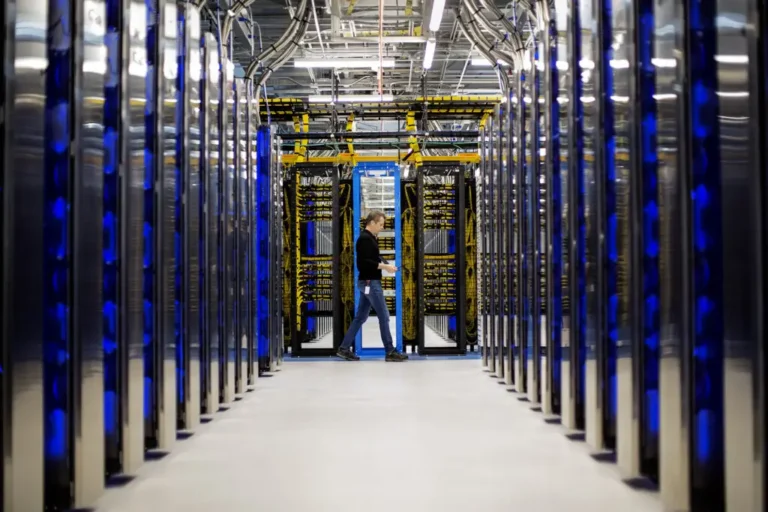




Brussels wants the EU to at least triple its data centre capacity within five to seven years. The companies that would fill those buildings reported earnings this week, and investors sold the shares of two of them whose AI spending is outrunning their cash. For anyone who rents cloud space or pays for European electricity, the question is who funds the buildings if the people who funded the American ones start counting the cost.
Table of contents
Alphabet lost an eighth in a day over cash
Alphabet reported on 28 October that quarterly capital spending reached $51.4 billion, up 114 percent on a year earlier, and that free cash flow was negative $9.1 billion, the second negative quarter in a row. The quarter before was the first time since its 2004 listing that Alphabet posted negative free cash flow.
Revenue of $127.6 billion, up 25 percent, fell short of the $128.2 billion analysts expected. The roughly 12.5 percent fall in the shares the next day was put down to renewed worries about AI investment.
Microsoft reported the same week. Azure grew 48 percent, revenue reached $92.3 billion against an expected $90.7 billion, net profit rose 32 percent to $36.6 billion, and free cash flow was a positive $18.6 billion. Its shares ended the next day down 0.2 percent and Meta’s rose about 2 percent, while the Nasdaq Composite fell 1.38 percent. The market sorted the spenders: it sold the companies with negative free cash flow and left alone the one whose revenue beat the forecast.
Amazon kept the bill and showed the debt
Amazon reported on 29 October. AWS, its cloud arm, grew 39 percent to $46.0 billion, its fastest pace in nearly five years, and produced about 63 percent of operating profit at its highest margin ever. But total revenue of $201.9 billion missed estimates slightly, and the company kept its plan to spend about $220 billion on capital projects this year. Shares fell more than 6 percent in after-hours trading.
The cash picture explains the reaction. Capital spending in the quarter was $75.9 billion, more than two and a half times operating income of $28.1 billion. Trailing free cash flow was an outflow of $42.4 billion, against an inflow of $14.8 billion a year earlier, and long-term debt of about $173 billion has nearly tripled since December. The Motley Fool’s Savannah Maxwell sums it up: “The cloud boom is real, but Amazon is now borrowing heavily to build it.”
Read also: Brussels wants triple the data centres
Amazon’s Jassy called the buildout “a once-in-a-lifetime opportunity” and expects cloud revenue growth of 40 percent or more in 2027 and 2028. The $220 billion itself dates from the July call, when Amazon lifted it from about $200 billion, with higher memory costs as the driver.
Microsoft’s CFO Amy Hood attributed $25 billion of the company’s $190 billion calendar-2026 capex plan to rising memory and component costs in April. The four companies’ combined 2026 plans were put at $725 billion then, up 77 percent from a record $410 billion last year. Part of that rise reflects higher component prices, which any European buyer of the same chips would also pay.
The Commission’s plan leans on private money
The Commission describes the Cloud and AI Development Act as the instrument that will “boost private investment in cloud and data centres”, with the goal to at least triple the EU’s data centre capacity within the next five to seven years. The same page gives no baseline for today’s capacity. Commentators translate the deadline differently: Tilburg Law School’s Annelieke Mooij and the European Economic and Social Committee’s Antje Gerstein both write “by 2030”.
The page lists €200 billion under InvestAI and €20 billion for up to five AI gigafactories. Amazon alone plans about $220 billion in 2026. Gerstein calls the tripling goal ambitious and says “financing remains uncertain”. She asks that cloud and AI infrastructure become a protected priority in the next long-term EU budget.
The act builds no power plants
Mooij’s assessment of the act is blunt. It “does not generate additional electricity capacity”, she writes, and does not ease network congestion or add water. Data centres consumed roughly 3 percent of the EU’s energy in 2024, she notes, citing a Commission energy item. Member states must designate Data Centre Acceleration Areas within six months of the regulation entering into force, and permits there must be decided within 12 months, but she warns the permits “may become a hollow factor”.
Gerstein makes the same point from the business side: “Faster permitting procedures and network connections alone will not be enough.” Mooij adds that the act has no division key for sharing capacity among member states. Hungary has 7.3 megawatts of IT power and Germany 2.6 gigawatts, according to the EU dashboard she cites.
Read also: Britain’s AI Champion Builds in West Virginia
The European Cloud Federation, a voluntary pool of capacity open to EU institutions and public bodies, lets providers recover costs but earn no profit. Mooij argues that may weaken the incentive to build surplus capacity. Article 15 obliges the Commission to gather demand data on critical infrastructure, so the demand figures for that part of the target are to arrive after the goal.
The strongest objection: AI spending meets real demand
Spenders say they cannot build fast enough. On Amazon’s July call, Jassy said he believes “this dynamic will also be true in 2027, too”. AWS reported a backlog of $496 billion. Microsoft expects to remain capacity-constrained through at least 2026, and Alphabet’s cloud backlog stood at $460 billion in April.
That is a case for building, and Europe has its own reason to build: the proposal aims for sufficient EU capacity for critical infrastructure by 2035, according to Mooij. But the complaint investors voiced this week concerned who pays and when, with revenue growth intact: AWS up 39 percent, Azure up 48 percent. A tripling target that waits on private money inherits that complaint.
Gerstein also asks for substantially greater weight on “European added value” when public contracts are awarded, and notes that procurement favouring established global providers would blunt the act. Public buyers are the demand that the act can steer most directly.
What the Commission still owes
Two things are missing from the Commission’s own description: a baseline for today’s EU capacity, and a named source for the money beyond private investment. The deadline is also loose. The Commission’s page says five to seven years, which counted from 2026 lands between 2031 and 2033, while two commentators write 2030.
Brussels set a target for buildings. This week investors showed they are setting one for cash flow, and the Commission’s plan for private money depends on theirs.
BASIS OF ANALYSIS
Basis of analysis. The analysis rests on eight sources: five press and trade reports on company results and spending plans, the Commission’s own page on its AI plan, and two commentaries on the Cloud and AI Development Act. The text of the proposal itself and the companies’ filings were not read, and the Alphabet and Microsoft earnings figures come from a single machine-translated report. Sources differ on the proposal date and the tripling deadline, so the text gives the Commission’s wording.
Sources
- Fortune via Yahoo Finance: Amazon shares sink as spending on AI overshadows growth in cloud unit (29 October 2026) – Amazon’s third-quarter revenue, AWS growth, capex plan and after-hours move.
- The Motley Fool: AWS Jumps 39% as Amazon’s Cash Flow Sinks: Rapid Earnings Reaction (29 October 2026) – Amazon’s free cash flow, debt, and the market closes for Alphabet, Microsoft and Meta.
- Seoul Economic Daily: Alphabet Plunges 13% on Capex Shock, Dragging Nasdaq Down 1.4% (30 October 2026) – Alphabet’s quarter and share move, and Microsoft’s quarter (machine-translated from Korean).
- Data Center Knowledge: Amazon Lifts 2026 AI Capex to $220B, Still Capacity-Constrained (31 July 2026) – The July capex increase, the memory cost driver, the backlog and Jassy’s capacity remarks.
- Tom’s Hardware: Google, Microsoft, Meta, and Amazon capex spending to hit $725 billion in 2026 (30 April 2026) – The FT-compiled combined capex, Microsoft’s memory cost share and the cloud backlog.
- European Commission: AI continent (page last reviewed 10 April 2026) – The tripling goal, the five to seven year window, the private investment aim and the funding figures.
- EU Law Analysis: The effectiveness of the Cloud and AI Development Act regarding data centres (31 July 2026) – Annelieke Mooij’s reading of permitting, energy, the capacity gap between states and the cloud federation.
- European Economic and Social Committee: Cloud and AI Development Act: how Europe can build capacity and strategic autonomy (September 2026) – Antje Gerstein’s view on financing, the 2030 goal and permitting.