


When a bank says its customers will lose nothing, someone still has. In the case of Crédit Mutuel Arkéa, it is the bank itself. Hackers have taken roughly 100 million euros of the bank’s own money, and it has ended up as cryptocurrency on exchanges in several countries. Customers have been told they are untouched. What the case does reveal is how much of a bank’s payment chain sits with outside suppliers, and who now spots a bank robbery first.
Table of contents
What the bank has confirmed
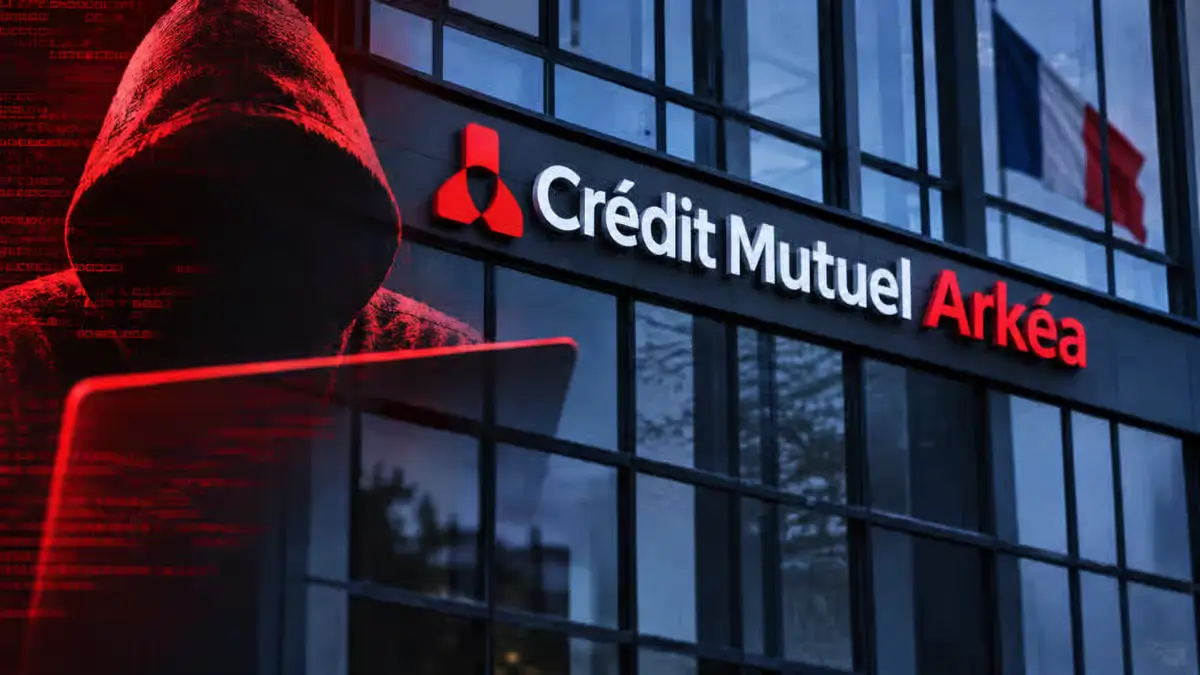
Arkéa, a Breton cooperative banking group, said on Wednesday 4 November that it had been hit by a cyberattack that allowed fraudulent transactions to be carried out. It describes the incident as “under control”. Certain transactions have been temporarily suspended to stop further movements and secure operations, and customers are told the episode has no financial consequences for them. The Banque de France is reported to have been notified but has declined to comment.
The bank did not at first confirm an amount. Later that evening it gave a provisional estimate of around 100 million euros, which it is trying to recover. The press has used 133 million dollars, roughly 118 million euros. The two figures are in the same range without being the same number, and the bank has only endorsed the order of magnitude. The final loss is unknown and may change as auditors and investigators take stock.
The money left the bank’s own account
The first reports described exchange accounts being drained. The bank’s own account points elsewhere: the attackers used Arkéa’s own account to send money to other banks, then converted it into cryptocurrency through specialised platforms. Access came, the bank says, through a supplier’s platform rather than its own systems, even though the damage landed on the bank directly.
Both descriptions can be true at once. Money can leave a bank as ordinary currency, arrive in an account at a crypto exchange, be converted into stablecoins and then be withdrawn. From the exchange’s side it looks like withdrawals from accounts. From the bank’s side it looks like outgoing payments. But nobody has published a complete path joining the two, and what we have is the bank’s version. It comes from the party with the most to gain from pointing outward, and no independent party has verified it.
Read also: Binance, North Korea and $6.3 Billion in Twenty Minutes
The supply chain is the weak link
If the attack did go through a supplier, the case is a lesson in how modern banks are built. A bank rarely owns its whole payment chain. Parts of it run at external providers, and each holds access that can in practice move money. An attacker does not need to break into the bank if the door stands open next door.
The EU has tried to close exactly that gap. The Digital Operational Resilience Act, known as DORA, has applied to the financial sector since January 2025. It sets requirements for oversight of ICT suppliers and for timely reporting of major incidents. Whether Arkéa or its supplier met them is unresolved, and nothing in the public record shows a breach has been established. But the question is obvious, and it is for the supervisors to answer.
Crypto was the escape route
The blockchain analytics firm Bitquery has traced 108.8 million dollars in the stablecoin USDC withdrawn from accounts at Kraken, Crypto.com and OKX over 21 hours on 1 and 2 November. The funds moved through hundreds of wallets, and much of it was swapped into ether. Crypto.com has blocked funds linked to the incident and says customer funds are secure. OKX froze an institutional customer account after unusual activity. Kraken has not responded.
The difference between the two assets matters in practice. A stablecoin has an issuer that can freeze addresses. Ether has none. Once the money has been swapped, there is no central place to call. That is why hours count: every hour that passes before anyone raises the alarm is an hour in which the funds can cross to the side of the line where they can no longer be stopped.
An anonymous investigator beat the bank to it
ZachXBT, the pseudonymous on-chain investigator, flagged more than 106 million dollars in suspicious withdrawals from a Western European financial institution on Monday 2 November. He later found another 27 million dollars, taking the total above 133 million. On Wednesday he named Arkéa and described an attack that ran over several days. His total could rise, he says, once over-the-counter (OTC) trades are counted.
He has also raised a criticism: because the incident was not properly disclosed, more than 30 million dollars were laundered that European authorities could have frozen. That is his claim, not an established fact. The timeline partly supports it, since the bank spoke publicly only once the name was already on Telegram. The bank says its own teams detected the attack, but when is not stated.
A regulated bank with 235 billion dollars in assets, by ZachXBT’s estimate, was thus exposed by an anonymous individual with a blockchain tool. That says something about how transparent crypto flows are, and how little comparable transparency there is in banks’ own communication.
Read also: Suspected Binance hack halts withdrawals, no EU licence
Who pays when customers do not
Arkéa brings together, among others, Crédit Mutuel de Bretagne and Crédit Mutuel du Sud-Ouest. It has member-owners rather than shareholders, so a loss of around 100 million euros ends up in the bank’s results and so in the equity its members ultimately stand behind. Against 235 billion dollars in assets, that is about half a thousandth. The bank is not going under because of it.
That makes the assurance to customers credible in a narrow sense. But a bank that promises “no consequences” has promised something only about customer accounts. It has not said how the attackers got in, and it has not said whether more parties may be affected.
Who is behind it
Nobody knows. ZachXBT says he has a high degree of confidence that North Korea’s Lazarus Group is not responsible, because of how the funds were moved. That sets the case apart from the Binance attack in late October, where about 6.3 billion dollars disappeared and the FBI has named North Korea. Two major crypto thefts within a week invite a link. There is no public evidence that they are connected, and the methods described suggest they differ.
What is still missing
Who is the supplier? How long did the attackers have access? How much has been frozen, and how much is gone for good? Which prosecutor is investigating, and what has the Banque de France been told? And when did the bank itself realise the money was leaving?
Until those questions have answers, customers have an assurance and the public has an investigator’s thread on Telegram.
SOURCES & METHOD
How this article was made. The analysis rests on the bank’s own statements as relayed by AFP, CoinDesk’s account of Bitquery’s and ZachXBT’s tracing, and BeInCrypto’s timeline. The attack route, the amount and the time of detection come from the bank itself and are not independently confirmed. The bank’s communiqué and ZachXBT’s Telegram posts were not read in the original. The description of DORA and of stablecoins versus ether is general knowledge, not checked against a source. The Binance figures come from secondary sources.
Sources
Euronews: Crédit Mutuel Arkéa reports cyberattack, says clients will be fully protected (4 November 2026)
The bank’s first statement and the reported amount.
Boursorama/AFP: Crédit Mutuel Arkéa: cyberattaque pour près de 100 millions d’euros (4 November 2026)
The bank’s communiqué: provisional estimate, route through a supplier and conversion to crypto.
Europe 1/AFP: Crédit Mutuel Arkéa annonce avoir été victime d’une cyberattaque (4 November 2026)
The bank’s wording and the suspended transactions.
CoinDesk: ZachXBT names French bank Crédit Mutuel Arkéa as suspected victim (4 November 2026)
Bitquery’s figures, the exchanges, ZachXBT on Lazarus and the bank’s statement.
BeInCrypto: ZachXBT Tracked a $133M Crypto Theft for Two Days
The 2-4 November timeline, the claim about 30 million dollars and the 235 billion dollar asset figure.
Cointelegraph via TradingView: ZachXBT identifies French bank as alleged victim of $133M crypto theft
That the attack method is undisclosed and the link not independently verified.
StealthEX: Binance Hack: Everything We Know About the $6.3B Theft
The scale of the Binance attack and the FBI’s attribution to North Korea.