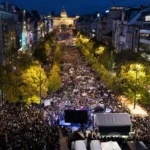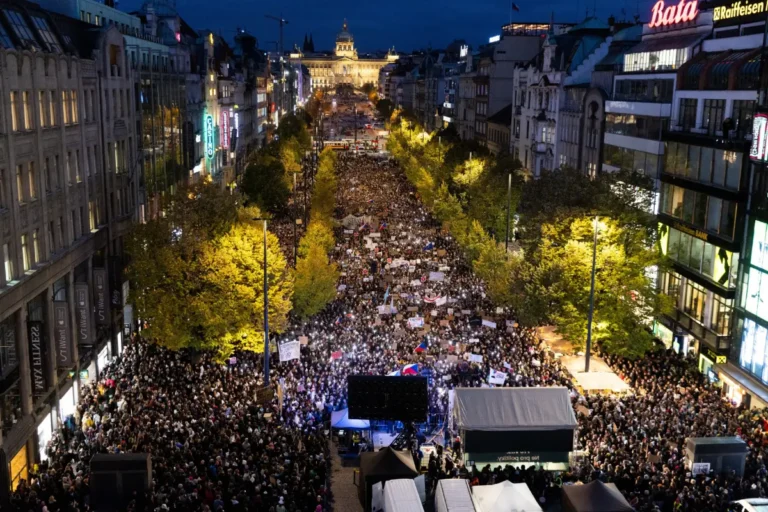



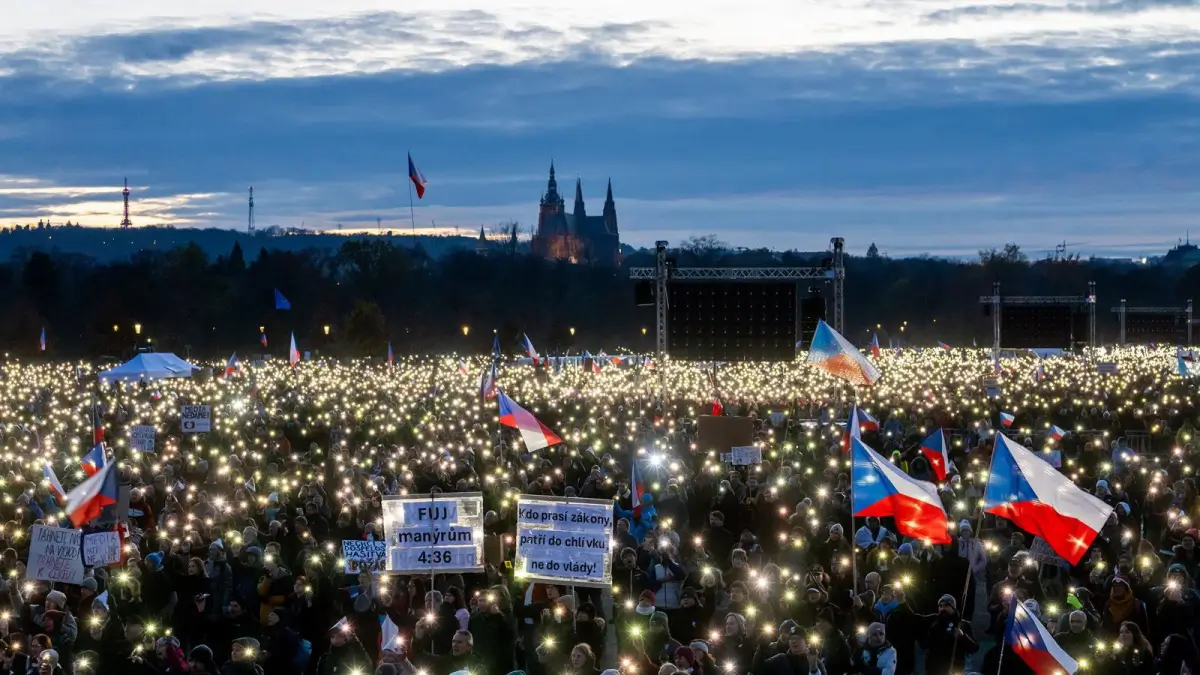
Between 350,000 and 450,000 people filled Letná Plain in Prague on Sunday, the organisers say, to stop the Czech media bill that would scrap the licence fee funding Czech Television and Czech Radio. Police published no count but confirmed it was the largest gathering they have monitored. Prime Minister Andrej Babiš answered the same day that the government will go ahead, and the coalition holds a majority in the lower house.
Table of contents
The crowd police will not count
The number is the organisers’ estimate. A police spokeswoman said that, as a matter of principle, police do not publish attendance figures, so the size of the crowd stays unverified. Medics treated 27 people, mostly for minor injuries and fainting, and the rally ended peacefully after about two and a half hours. Metro platforms and trains were overcrowded as people arrived.
The name, Letná against 4:36, points to the hour on 24 October when the governing coalition voted the bill through its first reading. Placards read “Hands off the media”. Students and signatories of Charter 77 addressed the crowd, and protesters also objected to government policy on a range of other issues, from justice to the environment.
The government’s answer in three voices
Babiš said he respects the right to protest but rejects its premise. The government is fulfilling its programme, he said, and “nobody wants to control public-service media”.
Read also: Czech public media strike over state-budget funding
Foreign Minister Petr Macinka of the Motorists asked in a televised debate what the organisers have done for citizens, and accused them of turning demonstrations into a business model. Parliament speaker Tomio Okamura accused them of promoting the views of opposition parties and cooperating with them.
The broadcasters’ side of the argument is numbers. The heads of Czech Television and Czech Radio say the cuts would cost up to 700 jobs, and more than 3,000 employees signed a petition against the bill. Staff of both broadcasters walked out for a day on 3 November, as we reported at the time.
What the Czech media bill does next
The bill would give Czech Television 5.74 billion crowns a year from 2027 and Czech Radio 2.065 billion, fixed sums indexed to inflation. For Czech Television that is about a billion crowns less than this year. The coalition wants the law in force in January 2027.
The bill has advanced to its second reading, and it still needs a third reading, approval by the Senate and the president’s signature. Opposition leaders have said they would obstruct it in the lower house and challenge it before the Constitutional Court if it passes, and the Pirate Party plans to take it to the European Commission.
The organisers demand that the bill be withdrawn, that the coalition apologise for the overnight vote and that the broadcasters’ future be openly debated. They have invited the government to a public debate at Švandovo divadlo in Prague on 2 December at 7 p.m. and announced a nationwide action for 4:36 p.m. that day. “It will not end with Letná,” chairman Mikuláš Minář said before the rally.
Read also: Trump’s BBC Suit Exposes Europe’s Press Law Gap
The EU rule the bill has to meet
The European Media Freedom Act requires member states to give public broadcasters “adequate, sustainable and predictable financial resources”. Fourteen media and press freedom organisations, among them the European Broadcasting Union and Reporters Without Borders, asked the European Commission in April to test the bill against that rule. The Commission is reportedly monitoring developments.
In a May letter to Babiš, the EBU warned that reduced funding, limited indexation and a lack of independent oversight risk creating financial dependency on political decisions. It also objected to parliament’s role in approving editorial codes.
Slovakia is the case critics point to. Its public broadcaster has been financed directly from the state budget since a 2024 law, with no specified annual allocation, a set-up two academics who track the sector say places it in “a relationship of severe dependency”. František Talíř of the opposition Christian Democrats, who chairs the Czech parliament’s media committee, says “we are copying Slovakia’s path”.
Sweden, when it moved to a tax in 2019, kept the money outside the state budget and let parliament fix allocations for a whole licence period.
President Petr Pavel has said that guarantees against political interference matter more than the funding model. The Czech bill will be judged on those guarantees in the readings ahead, in a chamber where the coalition holds 108 deputies.
SOURCES & METHOD
How this article was made. The article rests on ten sources, and neither the bill’s text nor the regulation’s text is among them. The wording of Article 5 comes from the press freedom groups’ statement, and the attendance figures are the organisers’ estimate.
Sources
- Radio Prague International: Prague hosts largest demonstration in Czechia’s modern history (15 November 2026) – police statement, organisers’ estimate, rally themes.
- Expats.cz: Echoes of 1989 on Letná, Prague protest largest since Velvet Revolution (15 November 2026) – police stance on counts, organisers’ demands, government reactions, bill status.
- dpa via Yahoo News: Hundreds of thousands protest media reform in the Czech Republic (15 November 2026) – estimate range, placards, Macinka’s remarks, Commission monitoring.
- Expats.cz: Huge Prague protest expected Sunday (13 November 2026) – rally name, 24 October vote, Minář’s statement.
- Radio Prague International: Concerns over public media independence in Czechia, as government unveils funding shake-up (15 April 2026) – bill mechanics, readings, staff petition, President Pavel.
- Radio Prague International: Funding shake-up sparks political storm over Czech public media (June 2026) – funding sums, job warnings, coalition majority, opposition plans.
- MFRR: Czech Republic, Public media funding bill raises concerns over compatibility with EMFA (22 April 2026) – Article 5 wording and the fourteen signatories.
- Broadband TV News: EBU warns Czech media reforms could undermine independence (8 May 2026) – the EBU’s letter to Babiš.
- Reuters Institute: Digital News Report 2025, Slovakia (17 June 2025) – Slovak broadcasting law and funding.
- Nordicom: Nordics replace licence fee with public service tax (updated edition of a 2019 article) – Swedish funding model.