
Czech public media staged a one-day strike on 3 November against a government bill that ends the household licence fee and pays Czech Television and Czech Radio from the state budget. Czech Television aired archived items and shorter bulletins, and Czech Radio played music with a minute of silence. The bill cuts their funding by about 15 percent from January 2027.
Table of contents
Silence on air
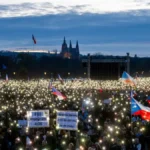
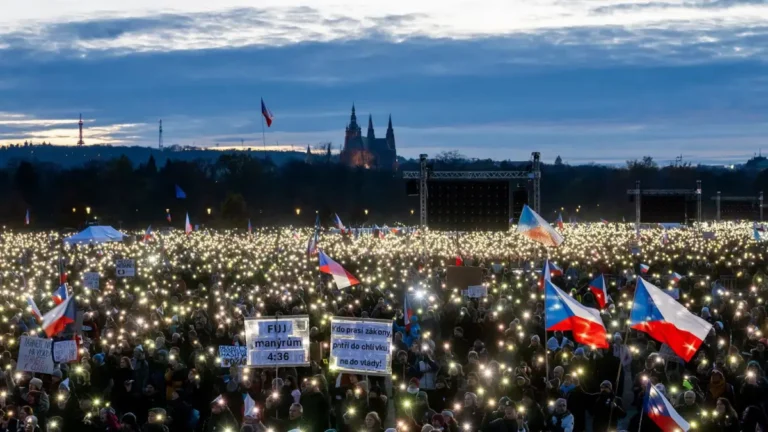
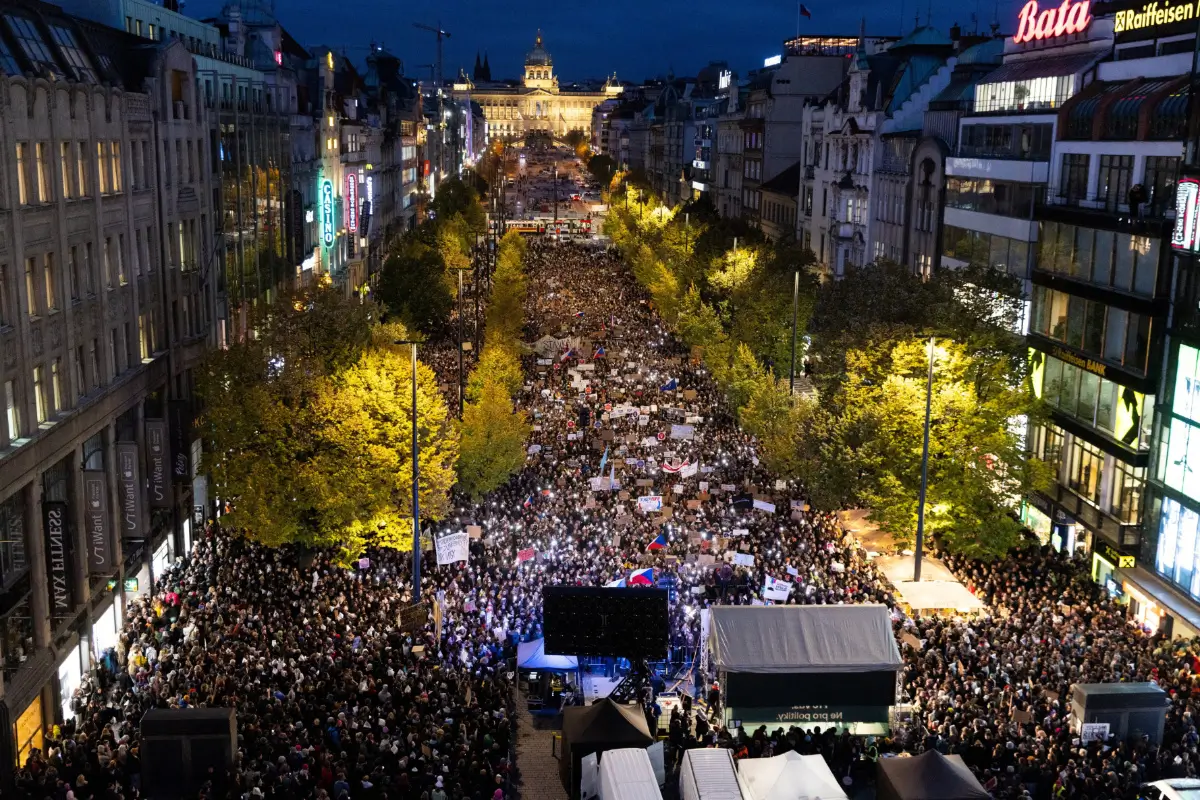
Thousands gathered on Wenceslas Square in Prague. Labour unions, university deans, churches, artists and athletes back the protest, and the next rally is set for Letná park on 15 November.
The bill cleared a first vote at 4:36 a.m. on Saturday 24 October and now goes to committee. Opposition parties failed to have it rejected or sent back to the government. In the Reuters Institute’s 2025 survey the two broadcasters ranked among the most followed and most trusted news sources in the country.
The money moves into the budget
Households pay 150 crowns a month for television and 55 for radio, and the fee stays payable until the law changes. The bill replaces it with budget money from January 2027: 5.74 billion crowns a year for Czech Television and 2.065 billion for Czech Radio. That is a loss of about 1 billion crowns a year for television and roughly 350 million for radio.
Read also: Europe’s Free Press Is Dying Quietly
A cut of about 15 percent would return television’s nominal budget to the level of 2008 and radio’s to 2005.
How the sum is set is described in two ways. Press freedom groups reading the April version say the amount is fixed and indexed to inflation with a five percent cap. A June statement from the European Broadcasting Union says annual allocations are determined through the parliamentary process. That difference decides who holds the lever every year.
Brussels has a rule for this
The EU Media Freedom Act demands funding that is “adequate, sustainable and predictable”, as the press freedom groups quote it, set by “transparent and objective criteria laid down in advance”. Those groups, including the European Federation of Journalists, Reporters Without Borders, the Broadcasting Union and Article 19, asked the European Commission in April to assess the bill under that rule.
No court has ruled against the bill. The groups’ statements are warnings about compliance.
In June the Broadcasting Union said the timetable left “insufficient time for public and parliamentary debate”. Without safeguards, it added, yearly allocations may raise the risk of political influence. Its examples of safeguards are a ring-fenced allocation, a multi-year framework and protection against arbitrary cuts.
The government says nobody is taking control
Prime Minister Andrej Babiš says the government is keeping a promise to lighten the financial burden on people. “Nobody wants to take over the public media or bring them under state control,” he said, and added that the bill could be changed in further debate.
Read also: EU Releases Hungary Funds Before Reforms Are Done
Culture Minister Oto Klempíř calls the amount “fair, predictable and indexed to inflation”. He says the two laws on the broadcasters’ operation and mission stay unchanged, and the government points to budget-funded models elsewhere in the EU. Babiš has described the payments as mandatory spending guaranteed by law.
Jan Molacek, a Czech Television reporter on the strike committee, says a change of funding is possible if it comes with a thorough debate and legal safeguards against meddling. Opposition parties compare the plan to Hungary under Viktor Orbán.
Hungary and Slovakia hang over the vote
Critics say the overhaul would let the coalition take control of the media, as populist governments did in Slovakia under Robert Fico and in Hungary under Orbán, who was ousted in April. The Czech coalition is Babiš’s movement with the far-right SPD and the eurosceptic Motorists.
The test arrives before the final vote. If the law fixes the sum for several years and shields it from annual bargaining, the safeguards the groups ask for exist. If parliament sets the money every year, the coalition that wrote the bill holds the purse over the newsrooms that cover it.
SOURCES & METHOD
How this article was made. The article rests on six sources, and the bill text itself is not among them. The wording of the Media Freedom Act is taken from the press freedom groups’ statement, and the exact funding mechanism could not be confirmed.
Sources
- Reuters via The Star: Czech public media launch strike, accusing government of political meddling (3 November 2026) – strike, 15 percent cut, Babiš and strike committee statements.
- AP via Yakima Herald: Czech public media workers go on strike over a government plan to overhaul their funding (3 November 2026) – broadcast curbs, protest backers, comparison with Slovakia and Hungary.
- MFRR: Czech Republic, public media funding bill raises concerns over compatibility with EMFA (22 April 2026) – joint statement on the bill, funding amounts and the Media Freedom Act rule.
- European Broadcasting Union: Concerns over Czech government plan to abolish the licence fee (22 June 2026) – joint statement on timetable, budget figures and safeguards.
- Radio Prague International: Government approves bill abolishing television and radio license fees – government approval, budget figures and the culture minister’s justification.
- Expats.cz: Why Czechia’s public media funding dispute has spilled onto the streets (26 October 2026) – fee levels, first-vote timing and the state of the bill.