
In July the European Commission published its 2026 Rule of Law Report and described the media freedom situation in the Union as broadly positive. The European Federation of Journalists read the same year and said the report seriously underestimates the decline in press freedom. Both documents can be defended line by line. The gap between them is the subject of this guide.
Table of contents
- The count behind the quiet
- Czechia: the live test
- Slovakia and Hungary: two ways in, and one way back
- Ownership, advertising and the regulator
- Italy and Serbia: slow pressure, no single moment
- Lawsuits as a weapon
- Spyware and sources
- What readers see: pressure from outside
- The toolbox and who uses it
- What is still open
Media capture rarely begins with a ban. It begins with a funding formula, an appointment, a lawsuit, a licence or a phone infected with spyware, and each step looks defensible on its own. The EU now has rules against most of these steps, namely the European Media Freedom Act (EMFA) and the Anti-SLAPP Directive. The open question is whether anyone enforces them in time.
This guide follows the pattern through eight places and tools: the numbers, the live Czech test, the Slovak and Hungarian cases, Italy and Serbia, lawsuits and spyware, outside pressure on what citizens read and see, the EU’s legal toolbox, and what is still undecided. It links to our reporting on each. Figures from advocacy groups are labelled as theirs.
The count behind the quiet
The Media Freedom Rapid Response monitor recorded 1,481 press freedom violations in 2025, affecting 2,377 journalists or media entities in 36 European countries, according to figures we cite in Europe’s Free Press Is Dying Quietly. The Council of Europe’s journalist safety platform saw alerts for the 27 member states rise more than 17% between 2024 and 2025. The Media Pluralism Monitor found favourable conditions for independent journalism in only six of 31 countries it assessed.
The Liberties Media Freedom Report 2026, based on contributions from nearly 40 organisations in 22 countries, reaches a similar verdict. It says media freedom and pluralism kept deteriorating in 2025 despite new legislation, driven by rising ownership concentration, opaque ownership, political use of state advertising and interference in public service media and regulators. These are civil society assessments, not official statistics, and we treat them as such.
The Commission’s own report is more upbeat on legislation than on practice. It welcomes the EMFA and the Anti-SLAPP Directive, and it says reforms are under way to align national laws with the EMFA. The EFJ says it is silent on delayed implementation, and that 22 countries have no journalist safety plan while the Commission welcomed plans from only a handful.
Our reading of the evidence is that the dispute is about timing more than substance. Nobody denies that the laws exist. The question is how long a government can ignore them before something happens to it.
Czechia: the live test
The Czech government wants to abolish the household licence fee that pays for Czech Television and Czech Radio and fund them from the state budget. The bill would give Czech Television 5.74 billion crowns in 2027 and Czech Radio 2.065 billion, roughly 1 billion and 400 million crowns below this year’s expected fee income, according to Radio Prague International and Expats.cz. Reuters describes the overall cut as about 15%.
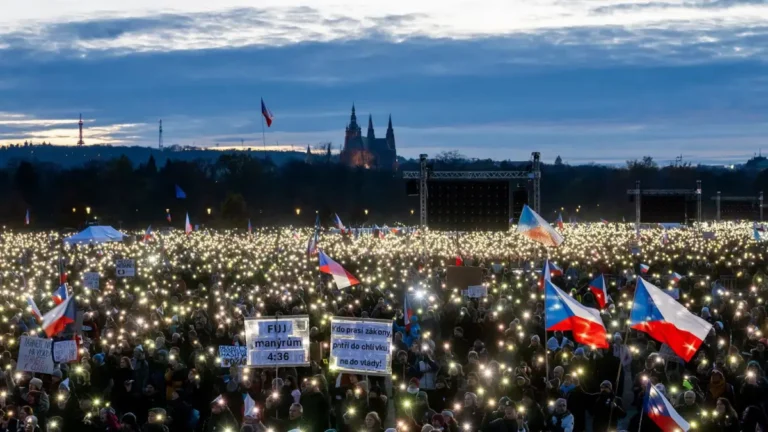
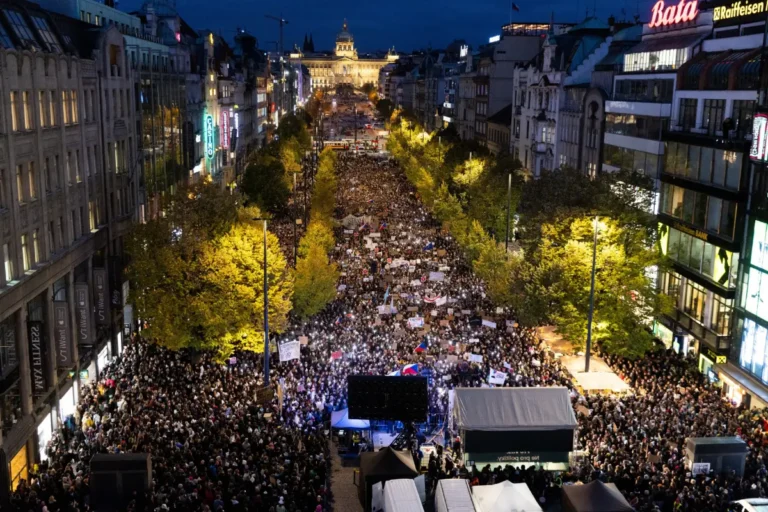
The bill passed its first reading at 4:36 on the morning of Saturday 24 October, and the hour became the protest’s name. On 3 November the broadcasters’ staff went on a one-day strike, as we reported in Czech public media strike over state-budget funding.
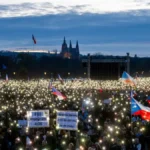
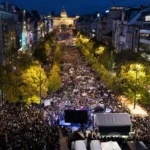
On Sunday 15 November the organisers said between 350,000 and 450,000 people gathered at Letná in Prague. Police published no count, so the figure is unverified, and the prime minister said the government would go ahead, as we describe in Czech Media Bill Stands After Letná Rally.
The EMFA requires public media funding to be adequate, sustainable and predictable and set by transparent criteria. Fourteen media and press freedom organisations asked the Commission in April to test the bill against that rule. The Commission is reportedly monitoring developments, and the Media Pluralism Monitor rates Czechia at a medium-high risk of 51% in 2026.
The government says nobody wants to control public media and that the sums are fixed and indexed to inflation. Critics read the text differently. Press freedom groups reading the April draft describe a fixed amount, while a June European Broadcasting Union statement says annual allocations are determined through parliamentary process. The difference decides who holds the lever each year.
The comparison cases matter. Slovakia finances its public broadcaster directly from the state budget since a 2024 law, with no specified annual allocation, a set-up two academics describe as severe dependency. Sweden moved to a public service tax in 2019, kept the money outside the state budget and let parliament fix allocations for a whole licence period.
What happens next is uncertain. A coalition minister said on 29 October that the second reading could come in January if proceedings stayed calm, which Expats.cz describes as a possible timetable rather than an announced date. The organisers invited the government to a public debate on 2 December. The opposition has said it would challenge the law in the Constitutional Court if it passes.
Slovakia and Hungary: two ways in, and one way back
Read also: Europe’s Free Press Is Dying Quietly
Slovakia captured its public broadcaster by law. In 2024 the government dissolved RTVS and created STVR, whose governance the Media Pluralism Monitor describes as dominated by the governing coalition. RSF says the STVR law is incompatible with the EMFA and that coalition representatives have filed abusive lawsuits against the press. Slovakia ranks 37th in RSF’s 2026 index.
The Slovak Constitutional Court has asked the EU Court of Justice preliminary questions on the STVR law, according to Via Iuris. The Commission’s own report records no progress on safeguarding public media governance. The case of the murdered reporter Ján Kuciak sits behind all of it, with a third trial that began in January 2026 against Marián Kočner and Alena Zsuzsová, as we describe in our earlier commentary. Eight years on, the case is in its third trial, earlier rulings were overturned by the Supreme Court, and no final verdict on who ordered the killing has been reached.
Hungary is the longest case study. Under Viktor Orbán, a conglomerate backed by his allies came to control more than 400 outlets, Al Jazeera reports. In December 2025 the Commission opened the first infringement procedure under the EMFA against Hungary, covering interference in journalists’ work, public media, ownership transparency and state advertising. In February 2026 the EU Court of Justice ruled that the closure of the radio station Klubrádió violated EU law.
Then Orbán lost the April 2026 election. Prime Minister Péter Magyar promised a system change, and the public media holding MTVA suspended its news programmes on 7 July, with M1 broadcasting an on-air apology for lying for years, Courthouse News reports.
The news returned on 20 August under the successor group Közmédia. The reform bill splits MTVA, restores the news agency MTI as a standalone body and creates an independent committee with equal representation from government, opposition and independent professionals, according to reports.
A new government that switches off a state broadcaster’s news to restore independence is asking for trust. That is our assessment, not a finding. RSF’s Hungarian representative says the real test is whether public media dares to criticise Magyar’s government on a factual basis, a test that cannot be passed in the first month.
The lesson from both countries is the same: a captured broadcaster is easier to build than to rebuild, and every rebuild runs through the institutions the previous government appointed.
Ownership, advertising and the regulator
Public broadcasters get the headlines, but the Liberties report puts the structural problems elsewhere as well. It lists rising ownership concentration, opaque ownership structures, the politicisation of state advertising and political interference in media regulators. It adds that regulators are vulnerable both to direct pressure and to indirect pressure through funding cuts. A regulator that cannot afford to act is as useless as one that is told not to.
Ownership is the quieter lever. RSF says a small group of oligarchs owns several major outlets in Slovakia, and the Media Pluralism Monitor rates Slovakia at a medium-high risk of 57% for 2026. In Hungary the conglomerate backed by Orbán’s allies reached more than 400 outlets, according to Al Jazeera.
For Czechia the Monitor notes a deterioration in ownership transparency linked to restricted public access to beneficial ownership data. A reader cannot weigh a story without knowing who owns the outlet telling it.
State advertising is the third lever, and it needs no law. A government that places its advertising budget with friendly outlets funds them and starves the rest, without ever touching an editorial decision. The Commission’s Hungary case lists state advertising allocation among the EMFA provisions it says Hungary breaches, and it is one of the few places where Brussels has already named the practice.
RSF’s year-one assessment concludes that most Member States are flouting the EMFA, and that many public media remain exposed to political pressure or budget cuts. It does record some progress, such as a requirement in Greece for all media service providers to disclose ownership information by the end of June 2026. We note that these are advocacy groups’ assessments of compliance. The Commission has not issued formal findings on most of these countries.
The practical consequence for readers is that a capture can proceed without a visible event. A funding formula changes in one country, an advertising contract moves in another, a regulator waits for a budget. Our guide treats these as one system, because the people who lose out do not see them as separate.
Italy and Serbia: slow pressure, no single moment
Italy shows capture without a dramatic bill. The Commission’s report finds no progress on reform of defamation, professional secrecy and the protection of journalistic sources, according to the EFJ. Its public broadcaster RAI has gone about a year and a half without a board chairperson, the same source says, and the government has cut its funding. Nothing in that list is a ban. Together it describes a broadcaster that cannot plan and a newsroom that knows who controls the budget.
The spyware case sits on top. In March 2026 Italian prosecutors confirmed that journalist Francesco Cancellato had been hacked with Paragon’s Graphite spyware, and prosecutors in Rome and Naples said a technical analysis found traces of spyware on his phone in December 2024. Who carried out the hack is not established, and the Italian government denies involvement. We covered the wider pattern in Pegasus Spyware Reached an MEP Investigating Pegasus, and the Italian case belongs with it.
Serbia is a candidate country, so the EU has leverage there that it lacks elsewhere. MFRR monitoring recorded 209 press freedom violations in Serbia in 2025, up from 84 in 2024, affecting 359 media workers or entities, though another MFRR summary counts 208. Police are documented as perpetrators in at least 38 attacks on journalists since 2025, according to the MFRR Serbia report, and the media regulator has been inoperative for more than 18 months. A country with that record sits on the road to membership, and the question for Brussels is whether accession talks measure it.
The pattern in both countries is slow pressure. No single day marks the moment a free press ended, which is why an annual report can describe the picture as broadly positive and remain technically defensible. We see that as the core weakness of the monitoring system, because each indicator moves by a small amount.
Lawsuits as a weapon
The cheapest way to pressure a newsroom is a lawsuit that costs more to fight than it costs the plaintiff to file. The EU answered with the Anti-SLAPP Directive, which Member States had to transpose by 7 May 2026. The European Anti-SLAPP Monitor found that none of the 27 had fully met the deadline by 8 May, according to Agence Europe. Press freedom groups called the transposition alarming and incomplete.
On 15 July 2026 the Commission opened infringement proceedings against 14 Member States for failing to communicate complete transposition, including Italy. They had two months to respond. If the answers are unsatisfactory, the Commission may issue a reasoned opinion, the next step before the Court of Justice. The International Press Institute notes that even where the directive was implemented, as in Malta, the reforms covered only cross-border cases and left domestic SLAPPs untouched.
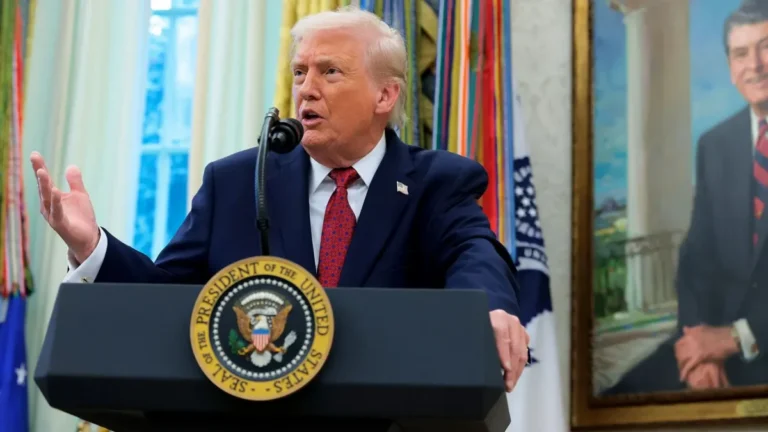
The Trump v. BBC case shows a different gap. On 10 November a federal judge in Miami allowed the defamation claim to proceed and dismissed a second claim under Florida’s unfair trade practices law, as we analysed in Trump’s BBC Suit Exposes Europe’s Press Law Gap. The BBC has apologised for the edit at issue, and, in a separate order, Trump has been told to give a deposition by 11 December. The ruling is partial and not final.
The European point is structural. The EMFA protects media against interference by states, and the Anti-SLAPP Directive covers abusive proceedings in the EU, including cross-border ones between Member States. A publisher in Paris, Madrid or Warsaw sued in a foreign court by a politician with money would find that neither text offers a shield. The Commission could publish how it intends to help a European outlet sued abroad, and we think it should.
The cost arrives before the verdict. Lawyers must be paid for years whatever the outcome, and an outlet with a smaller legal budget than the BBC faces that bill with less room to hold out.
Spyware and sources
Read also: Trump’s BBC Suit Exposes Europe’s Press Law Gap
The EMFA limits spyware use against journalists and protects the confidentiality of their sources, according to the Commission’s summary. In practice the cases keep arriving.
Citizen Lab published a forensic report on 3 July 2026 finding Pegasus on the phone of Stelios Kouloglou, a Greek journalist and former MEP who sat on the European Parliament’s spyware inquiry as a substitute member. The device was infected in October 2022 and again in March 2023, inside the inquiry’s working period.
Citizen Lab attributes the infections to NSO Group’s Pegasus with high confidence and does not name the customer. It found no indications that the Greek government is responsible. The geography, at least two EU jurisdictions, suggests to its researchers an operator licensed in several countries, and the report labels that an inference. We read the missing name as the heart of the matter, because a source who cannot learn who is listening has no reason to call.
The EFJ says legal proceedings over the surveillance of journalists in Greece and Italy have produced no results so far. Our own position is that spyware aimed at a reporter should be treated as a crime, and that the licence holder should be published. A law that limits spyware but never names a buyer is a rule without a defendant.
What readers see: pressure from outside
Capture is not only a domestic story. Foreign operators exploit the same weaknesses and borrow the vocabulary of independence. NewsGuard published a report on 28 September 2026 counting 906 fabricated reports styled as legitimate outlets since the full-scale invasion of Ukraine. The Pravda network, according to the American Sunlight Project, lacks original content and republishes from other pro-Russian sources. RT reportedly received 28.6 billion rubles from the Russian state in 2024.
We examined this in Independent Media Has Become the Kremlin’s Mask, and the broader security picture is in our hub on Russia’s shadow war in Europe. The link to this guide is simple. Where public media are weak and trust is low, readers drift toward sources that call themselves independent and answer to nobody visible. A captured or starved public broadcaster does not leave a vacuum. Something fills it.
The rules about who appears on screen matter too. On 8 October 2026 the European Court of Human Rights ruled in Atresmedia v. Spain that the Spanish electoral commission’s ruling that a five-leader television debate could not go ahead in its planned form did not violate the broadcaster’s freedom of expression. The Court called the room for restricting political speech before an election relatively narrow and accepted neutrality among competitors as a pressing social need.
We described the case in Strasbourg Lets Past Votes Decide Who Joins Election TV Debates. Europe has no common rule on who earns a podium, and the judgment shows regulators can decide it in advance.
The toolbox and who uses it
The EMFA has applied in most of its provisions since 8 August 2025. It covers editorial independence, the confidentiality of sources, limits on spyware, public media funding that is adequate, sustainable and predictable, transparency of ownership and state advertising, and a board of national media regulators.
The 2026 Rule of Law Report no longer issues recommendations on topics the EMFA now regulates, and the Commission says they are followed up through enforcement, including infringement proceedings and the Article 7 procedure.
The first enforcement step came in December 2025. The Commission sent Hungary a letter of formal notice, the first infringement procedure under the EMFA, covering interference in the work of journalists, public service media, ownership transparency, the assessment of market concentrations and state advertising. In February 2026 the Court of Justice ruled in the Klubrádió case that Hungary violated EU law by blocking the station’s frequencies.
That is the record so far: one EMFA infringement procedure, aimed at a government that has since been replaced, and 14 Anti-SLAPP procedures aimed at governments that missed a deadline. Both are real. Neither touches a country where a coalition is moving a funding bill through parliament as we write.
The Czech bill is the test of the enforcement logic. The EMFA rule on public media funding is clear in words, and the Commission is reportedly monitoring. If the Czech law is adopted with annual allocations set by parliament, the question becomes whether Brussels acts before the law takes effect, which Reuters says could be as early as next year, or after the damage is visible. The Media Pluralism Monitor, the Liberties report and the EFJ all say the Commission’s practice has been to wait.
What is still open
Several decisions are due, and none is settled.
In Czechia, the second reading could come in January, though a coalition minister called that a possible timetable only. The opposition has said it would go to the Constitutional Court if the bill passes. Whether the Commission opens a procedure is unknown.
In Hungary, the new public media structure is being built by a government with a constitutional majority. The test, as RSF’s representative put it, is whether public media criticises the government on a factual basis. That will take years to show.
In Slovakia, the Constitutional Court’s questions on the STVR law sit with the Court of Justice, and the Kuciak retrial has 42 hearing dates scheduled through the end of the year, according to our earlier reporting. Whether it ends in a verdict naming who ordered the killing remains to be seen.
On lawsuits, the Commission can issue reasoned opinions to the 14 Member States, and the BBC deposition on 11 December will show how far a foreign plaintiff can reach into a European broadcaster’s records.
Our view is that the distance between the law and its enforcement is the real story. The EU built the legal toolbox the profession asked for. Whether it uses it before a captured broadcaster is hard to undo is the question that matters, and readers can ask it of their own governments by name.
BASIS OF ANALYSIS
Basis of analysis: this guide rests on the sources above and on our earlier reporting. Figures from advocacy groups are labelled as theirs, and the bill texts were not reviewed directly.
Sources
- Commission: Rule of Law report strengthens EU democracy and fundamental rights (17 July 2026) – the report and the Article 7 and infringement follow-up.
- Commission Representation in Malta: 2026 Rule of Law Report (17 July 2026) – EMFA topics followed through enforcement.
- European Federation of Journalists: The EU Rule of Law report seriously underestimates the decline in press freedom (19 July 2026) – the journalists’ verdict.
- eucrim: Commission’s 2026 Rule of Law Report (14 September 2026) – report summary.
- Liberties: Media Freedom Report 2026 – trends, public media, regulators.
- Liberties: EU media freedom and journalist safety in crisis in 2025 (press release) – key findings.
- Peace Institute (Mirovni institut): Media freedom in the EU declines despite new legislation – scope of the Liberties report.
- Reporters Without Borders: One year on, most EU member states flouting the European Media Freedom Act – compliance assessment.
- Reporters Without Borders: Slovakia, Index 2026 – STVR law, oligarch ownership, SLAPPs.
- Media Pluralism Monitor: Slovakia 2026 – risk score.
- Media Pluralism Monitor: The Czech Republic 2026 – risk score, ownership transparency.
- IPI and MJRC: Slovakia Media Capture Monitoring Report 2025 – STVR appointees.
- Via Iuris: Zeitgeist 17, Slovakia – Constitutional Court questions to the Court of Justice.
- Expats.cz: Czech TV and radio fee bill could face next parliamentary debate in January (29 October 2026) – timetable.
- Expats.cz: Overnight protests mark Czech media funding vote (24 October 2026) – first reading, funding sums.
- Radio Prague International: Concerns over public media independence in Czechia – bill mechanics.
- Reuters via The Star: Czech coalition advances media overhaul in rushed overnight vote (24 October 2026) – 15% cut.
- MFRR: Czech Republic, public media funding bill raises concerns over compatibility with EMFA – EMFA test.
- Al Jazeera: Hungary’s Magyar urges president to quit, vows to overhaul state media (April 2026) – 400 outlets.
- Courthouse News (AFP): Massive shake-up of Hungary media after Orbán’s exit – 7 July suspension, RSF comment.
- CEE TV: Hungarian public news back on air after media reforms (24 August 2026) – 20 August bulletin, Közmédia.
- CEE TV: Hungary’s Tisza government unveils sweeping public media reform bill (15 June 2026) – MTVA restructuring.
- Commission: Commission calls on Hungary to comply with EMFA and AVMSD (11 December 2025) – first EMFA infringement procedure.
- Eunews: EU Court of Justice again rules against Orbán’s Hungary (26 February 2026) – Klubrádió judgment.
- Agence Europe: No EU Member State has met transposition deadline for Anti-SLAPP Directive – deadline missed.
- EAPIL: Commission opens infringement proceedings over Anti-SLAPP Directive transposition (16 July 2026) – 14 Member States.
- International Press Institute: Action against 14 states over Anti-SLAPP Directive delays – Malta example.
- MFRR: Anti-SLAPP Directive in Italy (5 August 2026) – formal notice to Italy.
- ExtraFokus: Europe’s Free Press Is Dying Quietly – figures and sources cited there.
- ExtraFokus: Trump’s BBC Suit Exposes Europe’s Press Law Gap – figures and sources cited there.
- ExtraFokus: Czech public media strike over state-budget funding – figures and sources cited there.
- ExtraFokus: Czech Media Bill Stands After Letná Rally – figures and sources cited there.
- ExtraFokus: Pegasus Spyware Reached an MEP Investigating Pegasus – figures and sources cited there.
- ExtraFokus: Independent Media Has Become the Kremlin’s Mask – figures and sources cited there.
- ExtraFokus: Strasbourg Lets Past Votes Decide Who Joins Election TV Debates – figures and sources cited there.
- ExtraFokus: Russia’s Shadow War in Europe: The Attacks Nobody Signs For – figures and sources cited there.
- AFP via The News: Russian disinformation surge hijacks Europe media (29 September 2026) – NewsGuard count of 906 fake reports.
- Ukrinform: Russia spends record amounts on international propaganda throughout 2024 – RT state funding figure, secondary source.