


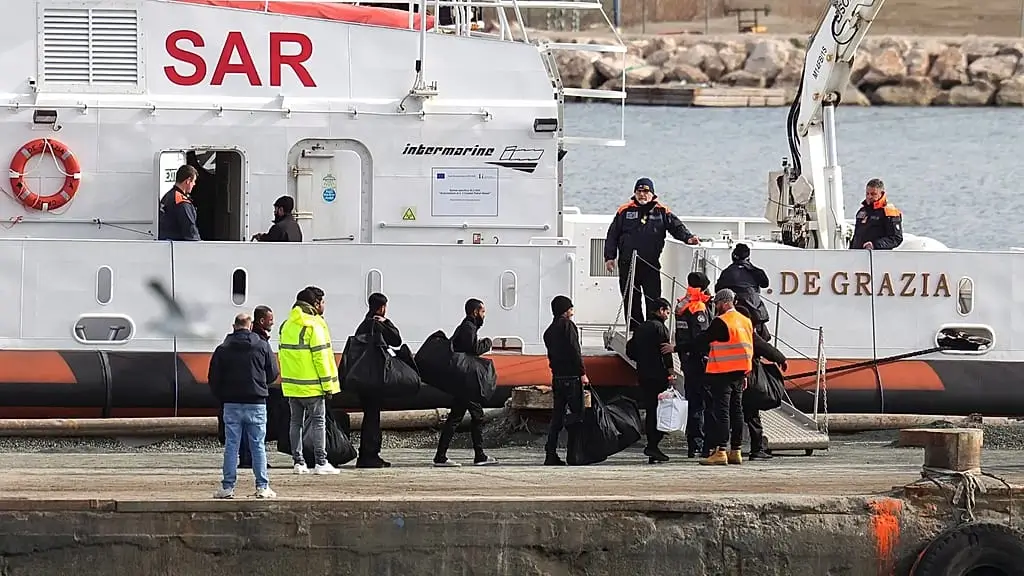
Return hubs outside the EU are now legal. A rejected asylum seeker in Europe can be sent to a centre in a third country, to stay there or to wait for onward travel. The Council gave its final approval to the Return Regulation on 1 October, and the hub provisions apply as soon as the text enters into force. No host country has been officially named, and the financial model has not been fully disclosed.
Table of contents
Return hubs got a rulebook before a site
The Council says a hub requires “an agreement or arrangement” with the non-EU country in question. That country must respect international human rights standards and the principle of non-refoulement (the ban on sending people to places where they face persecution or serious harm). Unaccompanied minors are excluded.
Provisions that need preparatory work apply one year after entry into force. The hub provisions do not wait: the Council says they apply immediately. The legal door is open while the practical groundwork, a host, a site and staff, is still being negotiated.
Parliament approved the text on 17 June by 418 votes to 218. Malik Azmani, the Dutch centrist MEP who sponsored the bill, said: “Today Europe delivered.”
Five governments are scouting for a host
Denmark, Germany, the Netherlands, Austria and Greece met in Copenhagen on 4 September. They agreed three principles: a measurable reduction in irregular migration, full compliance with EU and international law, and equal, mutually beneficial partnerships with non-EU countries. The European Commission sat in as an observer.
Next come missions to potential partner countries to test whether their standards meet those principles, and a common timeframe for the national legal processes. The principles set no figure for the reduction they promise.
Rwanda and Uganda have been mentioned as possible hosts, Kenya and Uzbekistan earlier in the summer, and none has been officially named. Greek press coverage describes a pilot for 5,000 to 10,000 people with rejected claims, with financial compensation for Uganda.
On 26 September, 18 European countries attended a migration meeting in Munich. Germany’s interior minister Alexander Dobrindt invited the group and EU Commissioner Magnus Brunner to a working lunch.
Read also: Frontex gets a 30,000 corps as rights oversight narrows
The safeguard is a clause in a contract
The compromise text sent to Parliament’s committee in June says such agreements should set out “an independent monitoring body or mechanism”. It adds that deficiencies in specific parts of a host country’s territory need not block an agreement if sufficient guarantees exist.
The same text says the agreements implement Union law within the meaning of Article 51(1) of the EU Charter of Fundamental Rights. And it asks member states to inform the Commission and the other member states before an agreement is applied provisionally or enters into force. The verb in the recital is inform.
The monitor is therefore written into a bilateral agreement that the sending government negotiates, and the text read here leaves the choice of body to that agreement. A hub’s first test is whether the body checking it can disagree with the government that signed it.
The case for hubs rests on a failing system
The strongest argument is the return gap. Jim O’Callaghan, Ireland’s justice minister, put it this way: “Around two in three people ordered to leave the EU do not actually leave.” In a typical quarter, about 117,500 orders to leave are issued and 33,860 people depart.
Brunner said the agreement shows the EU is “getting our European house in order”. The Cyprus presidency’s Nicholas Ioannides said the new regulation will speed up the return process.
None of these statements shows that a hub raises the number of departures. The five governments’ first principle promises a measurable reduction in irregular migration and names no target. Without one, the test of success is left to the governments that run the hubs.
The regulation also introduces a European return order, a form in which states record the key elements of a return decision to ease future mutual recognition. Recognition stays voluntary for now and is to be reviewed within three years of entry into force.
Read also: Brussels warns Italy over blocked asylum returns
Appeals do not stop the clock
The compromise text states that the regulation “does not provide for automatic suspensive effect of an appeal”. A removal can be suspended by the court of first instance, on the person’s request, and legal aid is available on request for those without resources. Appeals should be challenged before one judicial level where possible.
Detention should generally not exceed 24 months in a member state, with new periods of up to six months possible after that. For people judged a security risk, the Council says states may detain them longer than 24 months, and may issue an indefinite entry ban. The standard entry ban should in principle not exceed ten years.
The hub provisions sit on top of these rules. Remedies against a return decision stay with the court designated under national law. Whether the hub itself complies with the agreement is left to the body the agreement names.
Who pays is still open
Most EU governments agreed to seek EU money to run hubs, a move opposed by France and Spain. The costs are expected to fall mainly on the participating states, and host countries may be offered aid, investment or trade incentives. The full financial model has not been disclosed. Possible host demands include aid, visas, trade concessions, security support or direct payments, and none comes with a figure.
Greece’s prime minister Kyriakos Mitsotakis said his government would “conclude the first agreements for the creation of these structures in 2026”, with hubs operational from 2027. Denmark expects to begin moving people by the end of 2027.
Denmark’s immigration minister Morten Bødskov calls an exit-centre arrangement outside the EU a key priority for his government, one that must comply with all international obligations.
Europe has legalised a destination that does not exist yet
The pattern reaches beyond the five governments. Eighteen countries sat in Munich, and Gianni Berrino, an Italian senator, called the regulation “an important achievement”. France and Spain opposed the EU funding plan. Greece used the same Luxembourg meeting to argue for suspending asylum procedures during mass arrivals.
The text requires a monitor. The first signed agreement will show who appoints that body, who pays it and who can remove it.
BASIS OF ANALYSIS
Basis of analysis. The analysis rests on 11 sources. Three are official Council texts and two are releases from a national ministry. The Official Journal text of the regulation could not be read, so the provisions on detention and appeals come from the Council’s press release and the June compromise text, whose final wording may differ. Funding, candidate hosts and costs rest on press coverage of government statements and are unconfirmed.
Sources
- Council of the EU: Council adopts new rules on return for those with no right to stay in the EU (1 October 2026) – final adoption, hub conditions, application dates, detention and entry ban for security risks.
- Council of the EU: Council and Parliament reach deal on returns (1 June 2026, updated June 2026) – provisional deal, hubs, mutual recognition and next steps.
- Council of the EU: ST 10363/26, compromise text on the Return Regulation (10 June 2026) – recitals on hub agreements, monitoring, appeals and detention.
- Ministry of Immigration and Integration of Denmark: After crucial meeting, Core Group intensifies dialogue with partner countries on return hubs (4 September 2026) – the five governments’ principles and next steps.
- Ministry of Immigration and Integration of Denmark: the group meets again in Munich (26 September 2026) – Munich meeting, 18 countries, Dobrindt and Brunner.
- Africanews with AFP: EU lawmakers approve deportation hubs for migrants (17 June 2026) – Parliament vote, EU funding dispute, Mitsotakis statement.
- Euronews: The EU’s migration pact takes full effect (9 June 2026) – return figures, Brunner statement.
- EU Insider: EU adopts return rules that open the door to hubs outside Europe (3 October 2026) – O’Callaghan statement, Greek position at the Luxembourg meeting.
- Athens News: Return hubs, Greece and four other EU countries (4 September 2026) – Commission as observer, cost distribution, no host named.
- EU Today: Five EU governments open search for third-country return hubs (5 September 2026) – no host named, possible host demands.
- ProtoThema English: Rwanda and Uganda gain ground in plans to create return hubs (12 August 2026) – candidate hosts, pilot size.