


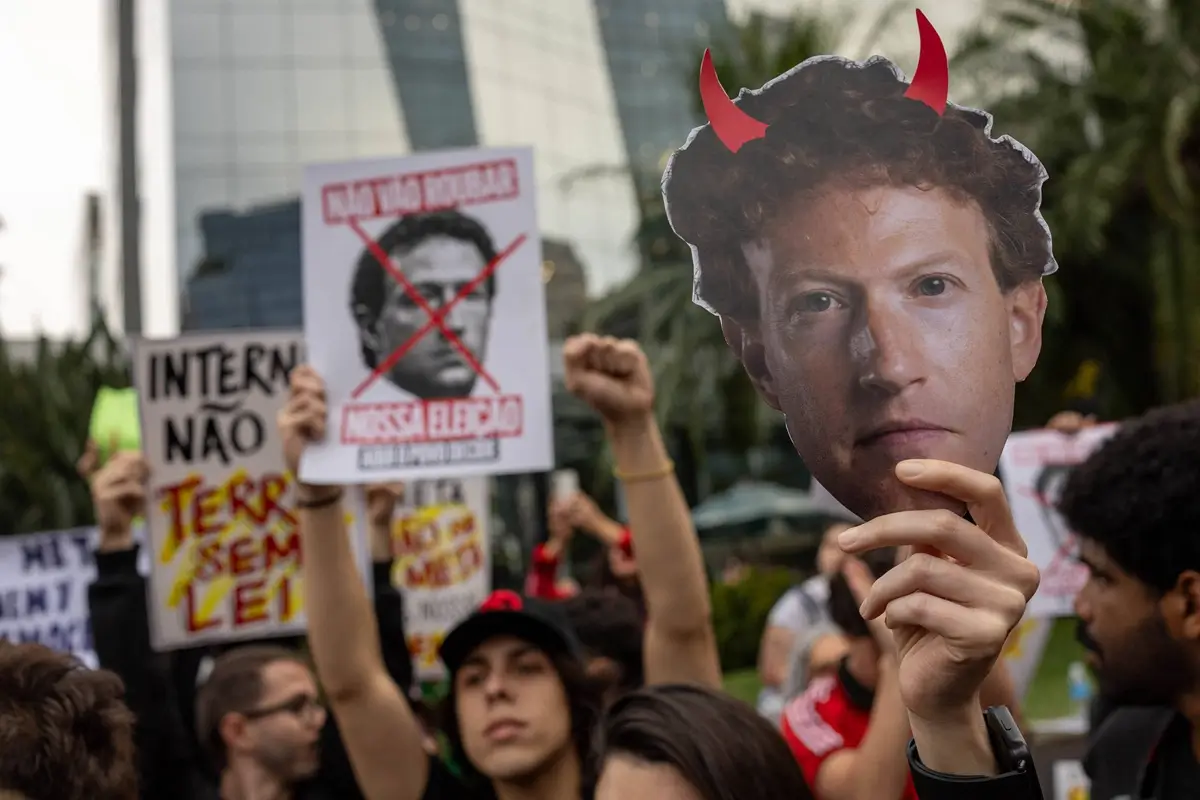
Brazil’s electoral court has ordered Meta to show that it treats the two presidential candidates equally, and has doubled a daily fine because Meta did not comply. The case began with an accusation from Lula’s campaign, which Meta denies. It offers a test for the Digital Services Act, although the Commission’s DSA page lists no election case against Meta.
Table of contents
What the court ordered
On 15 October Justice Marco Aurélio Bellizze of the electoral court, the TSE, ruled that Meta must adopt measures to secure equal treatment. Meta may not reduce the distribution of political content, restrict searches or remove posts in a way that creates imbalance, and its AI tool must apply identical criteria to both candidacies. The fine for non-compliance was 500,000 reais a day, about $98,000.
On 19 October the court doubled the daily fine to 1 million reais, about $200,000, after Meta failed to comply, and gave it 24 hours to show that it is not favouring either candidate in its feeds. The runoff between Lula and Flávio Bolsonaro was held on 25 October.
The complaint comes from Lula’s campaign. It says Meta kept his profile from being fully promoted on Instagram and from appearing in searches, and that supporters’ posts are removed disproportionately. The campaign also says Meta AI would not generate images of Lula while allowing them for Flávio Bolsonaro. No court finding that Meta manipulated its algorithm has been reported.
The order requires equal treatment and puts the burden of showing it on Meta.
What Meta says
Meta rejects the accusation. In a statement on 16 October it said: “Brazilian voters deserve facts, not a political narrative constructed by combining unrelated technical issues.” It says each incident the campaign cites has a documented explanation, and that it will keep defending itself in court.
Read also: Brussels Fined Big Tech 2.46 Billion. Washington Threatens Tariffs
Meta explained the AI image problem as a loophole involving generic first names combined with electoral numbers. It also pointed to two global technical disruptions in October, one freezing Instagram Reels view counts in more than 100 countries and one hitting its ad-creation tool for a day. Meta admits some Lula campaign ads were taken offline temporarily because of technical errors.
Two outlets describe a Folha report on internal Meta messages differently. AP says employees acknowledged that Lula’s accounts were restricted because of glitches and algorithmic limitations, with engineers blaming system failures. Novara Media says Instagram staff admitted that the algorithm favoured Bolsonaro. The two accounts point in different directions, and the Folha text is the document that would settle it.
The wider record on political ads
A study by the Federal University of Rio de Janeiro found at least 1,613 irregular political ads between July and September, with 171 million views and about 2 million reais in revenue, mainly funded from the United States. Researcher Marie Santini described it as systematic behaviour by the company.
Amnesty International’s August test found that Facebook accepted 7 of 15 test ads, including one calling for a military takeover, although Amnesty says none were published.
On 25 September Meta briefly suspended ads on Lula’s Facebook page, and his team filed a complaint through the platform’s own systems.
How the DSA’s tools compare
The Digital Services Act covers platforms with more than 45 million monthly users in the EU. The Commission’s DSA page, last updated on 19 May 2026, says they must assess systemic risks including risks to “public security and electoral processes”, and that mitigation could mean adapting their design or changing recommender systems. The Commission adopted election guidelines on 26 April 2024 to support compliance with Article 35.
The same page lists an annual independent audit, a public advertisement repository, a recommender option not based on profiling, and vetted researcher access to data. Each could bear on the Brazilian allegations: an ad repository would show who ran irregular political ads, and researcher access could test claims about reach. The Commission is primarily responsible for enforcing the additional obligations for the biggest platforms.
Read also: The Digital Omnibus Follows Big Tech’s Wish List Closely
The speed differs. Brazil’s court set a daily fine and doubled it within four days, from 15 to 19 October. The DSA route runs through risk assessments, audits and Commission proceedings. Recent actions on the Commission’s DSA page include preliminary findings against TikTok on recommender systems on 6 November 2026, a €550 million fine on AliExpress on 20 July 2026 and an action plan accepted from X on 16 July 2026.
The DSA page lists no election case against Meta.
The EU’s political advertising transparency regulation offers a second European yardstick for how a platform’s ad moderation is judged.
What the DSA can learn
Three points follow from the Brazilian order. It sets an equal-treatment standard that can be tested against a platform’s own data. It puts the burden of proof on the platform. And it attaches a daily cost to delay. The DSA has instruments for the first two in principle, and it is not known whether the Commission would move on the same timetable in a member state’s national election.
The comparison has a limit. The Brazilian order answers an accusation that has not been proven, and Meta’s explanations are on the record beside the campaign’s. A test of equal treatment cuts both ways: if the platform’s own data shows balance, the burden is met, and if it shows imbalance, the order already contains the consequence.
Part of our guide to who writes Europe’s laws: Who Writes Europe’s Laws and Who Watches Them
BASIS OF ANALYSIS
Basis of analysis. The analysis rests on 9 sources, among them two AP reports and three Commission pages, none of them the court order itself or Meta’s full reply. No Commission case against Meta was found.
Sources
- AP via BNN Bloomberg: Lula wins electoral court challenge against Meta (15 Oct 2026) – the ruling, the first fine.
- AP via ClickOnDetroit: Meta denies accusation of anti-Lula bias (16 Oct 2026) – Meta’s reply, the ad study.
- Al Jazeera: Brazilian court orders Meta to prove Lula and Bolsonaro get equal treatment (19 Oct 2026) – the doubled fine, the 24-hour order.
- Novara Media: Top Brazilian court fines Meta 200k per day (21 Oct 2026) – the fine, the Folha report.
- Next: Au Brésil comme en Europe (29 Sep 2026) – the 25 September ad suspension, the EU comparison.
- netzpolitik.org: Facebook lässt Wahlwerbung mit Desinformation zu (25 Aug 2026) – Amnesty’s ad test.
- European Commission: DSA, very large platforms (updated 19 May 2026) – systemic risk and mitigation duties.
- European Commission: Election guidelines for very large platforms (adopted 26 Apr 2024) – Article 35 guidance.
- European Commission: The Digital Services Act (updated 1 Oct 2026) – enforcement role, recent actions.