


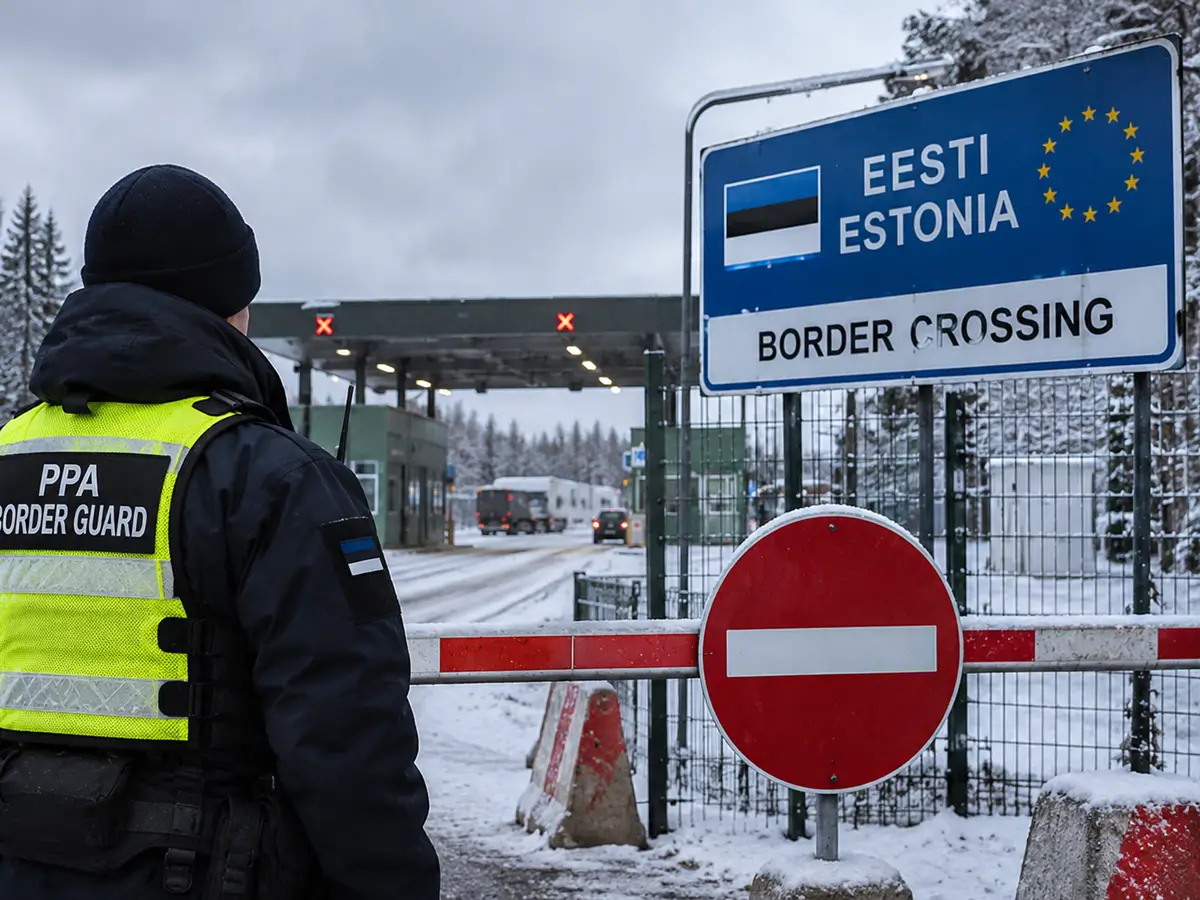
All crossing points between Estonia and Russia are to close on 1 December, Estonia’s foreign ministry says, after a failed arson attack on a drone factory outside Tallinn. Estonia’s security service, Kapo, attributes the attack to Russian military intelligence, the GRU. The eight people detained lived in Latvia, which raises the question of what a closed Russian border can stop.
Table of contents
- Eight Latvian residents and a failed night at a drone factory
- The Russian border closes before the government has voted
- The suspects lived inside the Schengen area
- A second Estonian drone supplier hit, again via Latvia
- The same recruiting model runs from Poland to Bulgaria
- The closure has a case, and a limit
Eight Latvian residents and a failed night at a drone factory
The attempt came at 3.06 a.m. on Saturday 14 November at Threod Systems in Viimsi, north of Tallinn, Prosecutor General Astrid Asi said. Kapo’s director general, Margo Palloson, says the plan was to break windows, pour in flammable liquid and cause a fire and an explosion. The factory’s own security staff stopped it. Nobody was hurt, damage was not significant and production and deliveries are unaffected.
Threod builds long-range reconnaissance and attack drones, and its Cata B catapult launcher was used in British strike-drone launches from HMS Queen Elizabeth in October trials.
Eight people were detained, all residents of Latvia. Latvian authorities say four are Latvian citizens and four hold Latvian non-citizen status, and several have previous convictions. Prosecutors have asked a court to jail five. Latvia’s State Security Service searched nine sites in Latvia and found explosive devices, pyrotechnic articles, ammunition, and many phones and data storage devices.
Kapo says Estonian counter-intelligence has established that Russia was behind the attempt, coordinated by the GRU. Asi says the criminal case must establish how the attack was organised. Moscow gave no immediate comment.
Read also: Russian Sabotage in Europe Runs on Paid Amateurs
The Russian border closes before the government has voted
Estonia’s foreign ministry said on X on Sunday that Estonia will close all crossing points with Russia as of 1 December. Prime Minister Kristen Michal was more cautious: Estonia is preparing for the possibility of closing the border. Interior Minister Igor Taro will propose closing all road crossings to pedestrians and vehicles, and the government is to decide in the coming days, including whether the closure is temporary or indefinite.
Estonia has three open road crossings with Russia, at Narva, Luhamaa and Koidula, open to pedestrians and lorries from 7 a.m. to 7 p.m. Estonian residents and lorry drivers in Russia have two weeks to return home. Taro says Estonia has already restricted traffic to and from Russia significantly, and that the moment for a full closure has now arrived.
Foreign Minister Margus Tsahkna says closing the crossings will reduce Russia’s ability to conduct hostile activities in Estonia. Michal says it will reduce the threat to people in the country.
The suspects lived inside the Schengen area
Palloson describes the GRU’s method as recruiting EU residents who can move freely in the Schengen area for physical attacks and sabotage. By his account the recruits come from criminal circles and from people in difficult social and economic circumstances. The eight suspects lived in Latvia.
The sources do not say how the eight entered Estonia or who in Russia gave the order. A closed Russian border limits traffic between Russia and Estonia. Travel between Latvia and Estonia is unaffected. If the method is to hire people who already live inside the EU, the closure gives Russian agents fewer routes into Estonia and leaves the recruiting of locals untouched. That conclusion is ExtraFokus’s own assessment.
A second Estonian drone supplier hit, again via Latvia
On the night of 15 August a suspected arson attack hit the defence technology company Milrem Robotics in Tallinn. Latvia’s State Security Service opened a case the next day and detained three Latvian citizens on 17 and 18 August, suspected of assisting a foreign state in actions against another state and of arson. It searched seven sites and seized large amounts of data media. Kapo attributes the fire to Russian special services.
An Estonian court approved pre-trial detention for two of the three, according to Euromaidan Press. Milrem’s chief executive, Kuldar Väärsi, told Reuters the fire did not disrupt deliveries to Ukraine, and the company says it expects more than 200 of its unmanned ground vehicles in Ukrainian service by the end of the year.
At the end of September Tsahkna called the attack sabotage ordered by Russia’s special services and summoned the Russian ambassador. Kremlin spokesman Dmitry Peskov called the accusation baseless.
Read also: Satellite images show a giant radar in Kaliningrad
So both attempts on Estonian defence firms this year rest on suspects from Latvia: three citizens in August, eight residents now.
The same recruiting model runs from Poland to Bulgaria
A Vot Tak count of physical incidents, with cyberattacks and influence operations excluded, finds at least 52 in 17 European countries between 1 April and 15 October. Officials link 48 to Moscow or describe them as possibly part of Russian operations, and four to Minsk. Poland has the most, nine, including arson at a Starlink station and attacks on defence enterprises. A recruiter offered an undercover reporter the task of setting fire to or blowing up the drone maker Flytronic.
Romania and Latvia have six incidents each and Lithuania five. Germany has had attempts at Leipzig airport and the Wunstorf air base, and in Bulgaria saboteurs set fire to a Starlink facility and an ammunition plant.
Denmark’s intelligence service PET said in early September that Danish companies are targets of concrete Russian sabotage planning, and that Russia recruits Danes over social media and gaming platforms, among other things to photograph companies and infrastructure. In October an unnamed PET official said there is a lot of planning and little carried out. Russia’s embassy in Copenhagen denies the allegations.
The closure has a case, and a limit
The government’s case is that a closed border reduces Russia’s ability to act inside Estonia. Finland closed its crossings with Russia in November 2023 for a different reason: it said Russia was steering a rise in asylum seekers without valid documents towards the border.
The eight lived in Latvia. The recruiting, in Palloson’s account, happens among people who already live inside the Schengen area, and no border post sees it.
BASIS OF ANALYSIS
Basis of analysis. The analysis rests on eleven sources: two reports from Estonian public broadcaster ERR, Reuters texts carried by Al Jazeera, ThePrint and Devdiscourse, Estonian World, Euronews, Euromaidan Press, Novaya Gazeta Europe, Chatham House and the press release of Latvia’s State Security Service on the Milrem case, which is the only primary document. The government decision, Kapo’s own statement and the prosecutors’ court application were not read, and the statements about the GRU are Estonia’s own. It could not be confirmed how the eight entered Estonia or whether the government has decided on the closure.
Sources
- ERR News: 8 detained after attempted arson at Estonian defense company Threod Systems (15 Nov 2026) – arrests, timing and statements from the prosecutor and Kapo.
- ERR News: Estonia to close border crossings with Russia after GRU-linked sabotage attacks (15 Nov 2026) – crossings, 1 December and the coming government decision.
- Al Jazeera and Reuters: Estonia to close border crossings with Russia after attack on drone maker (15 Nov 2026) – the foreign minister’s reasoning and Moscow’s lack of comment.
- Estonian World: Estonia plans to close its road crossings with Russia after an attack on drone maker Threod (15 Nov 2026) – citizenship of the suspects, searches in Latvia, the custody request and Threod’s launcher.
- Latvian State Security Service: VDD detains three Latvian citizens on suspicion of arson in Estonia (20 Aug 2026) – detentions, charges and searches in the Milrem case.
- Euromaidan Press: Arson did not disrupt Ukraine deliveries, Estonian military robot maker says (20 Aug 2026) – Milrem’s statement on deliveries and the court decision on detention.
- Euronews: Estonia accuses Moscow of arson at Milrem Robotics (29 Sep 2026) – Estonia’s formal accusation and the Kremlin’s rejection.
- ThePrint and Reuters: Russia recruits Danes for sabotage planning, Denmark says (3 Sep 2026) – PET’s statement on recruiting Danes.
- Devdiscourse and Reuters: Denmark says Russia has attempted acts of sabotage against its defence firms (8 Oct 2026) – the PET official’s statement and the embassy’s denial.
- Novaya Gazeta Europe: More than 50 incidents in Europe in half a year (24 Oct 2026) – the Vot Tak count of incidents in 17 countries.
- Chatham House: Russia’s withdrawal from its border agreement with Finland (30 Jan 2024) – Finland’s border closures in November 2023.