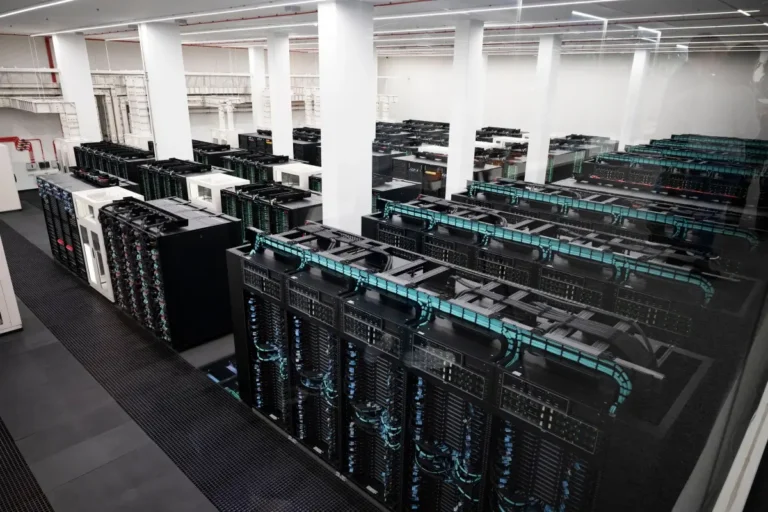



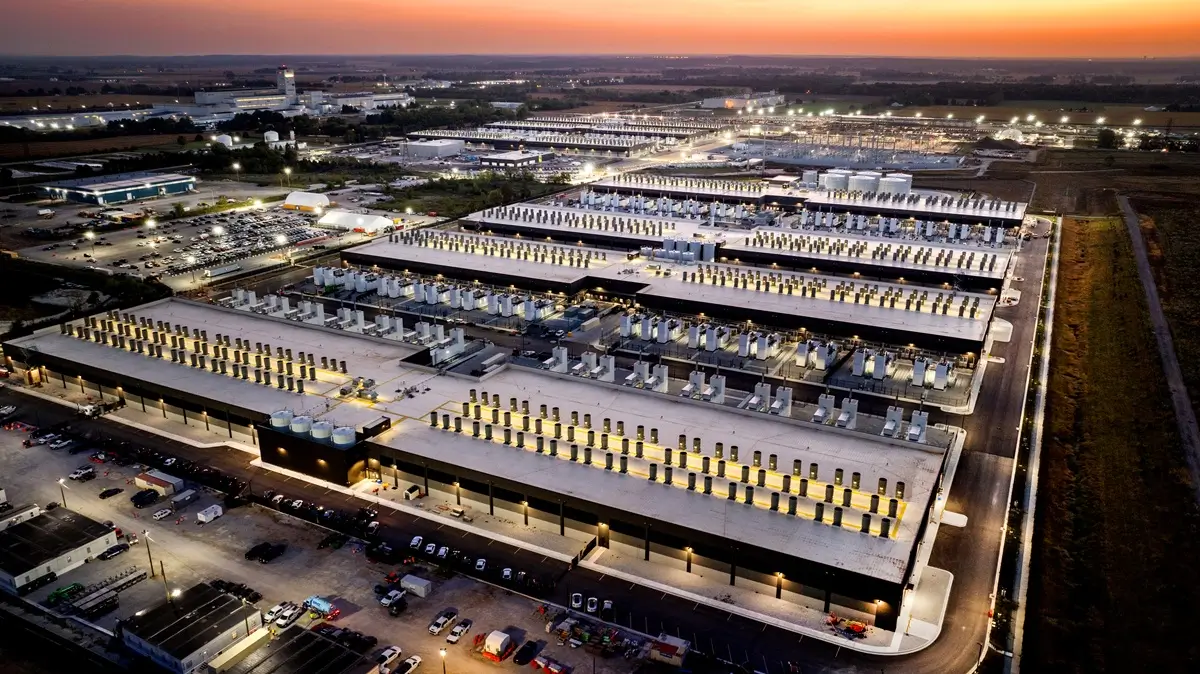
A plan to triple Europe’s data centre capacity is moving through Brussels just as Harvard researchers have counted what the largest such halls emit in the United States. If you pay an EU electricity bill or live near a planned site, the arithmetic is yours. The researchers put the annual emissions of 403 US hyperscale data centres (the very large facilities run by big tech) at about 25.7 million tonnes of CO2, and wire reports set that against a whole country: Denmark.
Table of contents
Data centre emissions, counted from orbit
The team behind the study, published in Nature Sustainability on 16 November, mapped the 403 facilities from satellite imagery. For each one they estimated electricity use between May 2024 and April 2025, and they worked out emissions from the power mix of the grid region where the site sits, using data from the US Environmental Protection Agency.
The result is about 25.7 million tonnes of CO2 in a year, two to three times an earlier estimate from 2018. Electricity use falls between 68 and 99 terawatt-hours depending on the scenario, about 1.8 percent of US consumption. Some 54 percent of that power came from fossil fuels, mostly gas, about 38 percent, and coal, about 15 percent.
AP gives the same emissions as 28.3 million US short tons, so the two figures are one figure in two units. AP says an electricity use of 82 terawatt-hours is enough to power nearly 7 million homes for a year. Lead author Gianluca Guidi, a postdoctoral fellow in biostatistics at Harvard, describes the result as a snapshot of a rapidly expanding industry.
The comparison with Denmark belongs to the wire services. AP says the facilities emit more than the entire country does in a year, Reuters says as much. Francesca Dominici, the senior author and director of the Harvard Data Science Initiative, picks a US state such as Michigan or a small European country.
The authors list their own limits. They lacked data to cover every US hyperscale site, they could not separate AI workloads from ordinary use, and they have not measured health effects. Dominici warns: “We are going backwards toward the goal of controlling CO2 emissions.”
Read also: Europe Runs on Computers It Does Not Own
Measuring health effects is the authors’ planned next step. The work was funded by US federal research grants, from the National Institute of Environmental Health Sciences and the National Institute on Aging, according to the release. The figures cover May 2024 to April 2025, so they describe a year that is already over, and the researchers call the result a snapshot of a market that keeps growing.
Brussels sets its target in capacity
On 3 June the Commission proposed the Cloud and AI Development Act (COM(2026) 502). Its explanatory memorandum says the aim is to triple EU data centre capacity within five to seven years and to reach the capacity Europe needs by 2035. A separate estimate of about EUR 200 billion, mostly private money, appears in press coverage of the plan and not in the memorandum text.
It is a proposal. Parliament and Council decide it together under the ordinary legislative procedure, and the opinions of the European Economic and Social Committee and the Committee of the Regions were still pending when the Council received it. It sits in a technological sovereignty package beside a second Chips Act.
To get there the proposal creates a mechanism to identify and support strategic data centre projects, with sustainability built in, and borrows the idea of one project, one procedure from the Industrial Accelerator Act. The Commission’s Regulatory Scrutiny Board gave the underlying impact assessment a positive opinion on 8 May 2026, with a request for improvements. The memorandum also notes that the Digital Decade programme has no compute or data centre target.
The memorandum gives its reason in market terms. Three non-EU hyperscalers control more than 70 percent of the EU cloud market, and the share of EU providers fell from 29 percent in 2017 to 15 percent in 2022 and has stayed flat since.
The grid sets the carbon price
Harvard’s numbers show why capacity and emissions travel separately. Virginia, Oregon, Ohio and Iowa together account for more than half of the electricity use the study covers, and about a quarter of the demand sits in grid regions dirtier than the US average. The same hall emits more or less depending on who generates the power behind it.
The Commission’s memorandum names the grid too, but as a question of availability. Location decisions should take grid availability into account, it says, and information should be shared early so grid planning can follow, in step with the European Grids Package.
On sustainability the memorandum points to the rating scheme under the Energy Efficiency Directive to identify sustainable data centres. It states that the framework “does not set incentives” for operators to improve their sustainability performance beyond transparency and reputation.
Where the grid already says no
The same constraint is visible at national level. Denmark’s grid operator Energinet wrote on 13 November that new very large consumers such as data centres are hard to connect, with about 2 GW of data centres connected or agreed, and an emergency plan places them in the last two of four priority categories.
Read also: Who really guards the AI chip supply
The loudest critics ask who owns the halls
The criticism of the Commission plan quoted in trade coverage concerns sovereignty. ITdaily reports that the plan is accused of not going far enough and of leaving too much room for non-European hyperscalers. The industry group CISPE argues that the sovereignty criteria could let US providers score well, as ITdaily relays it.
TNW’s own reading is that AWS, Azure and Google Cloud would find the top sovereignty tiers difficult, if not impossible, to meet as written. Executive Vice-President Henna Virkkunen is quoted there: “We want to be sure nobody has a kill switch.”
Who owns the halls is a legitimate question for a sovereignty law. What the halls emit goes unanswered in the criticism quoted here, and ITdaily adds that funding for the plan is unclear and that some offers branded sovereign may be so only in name.
A voluntary pledge meets a measured problem
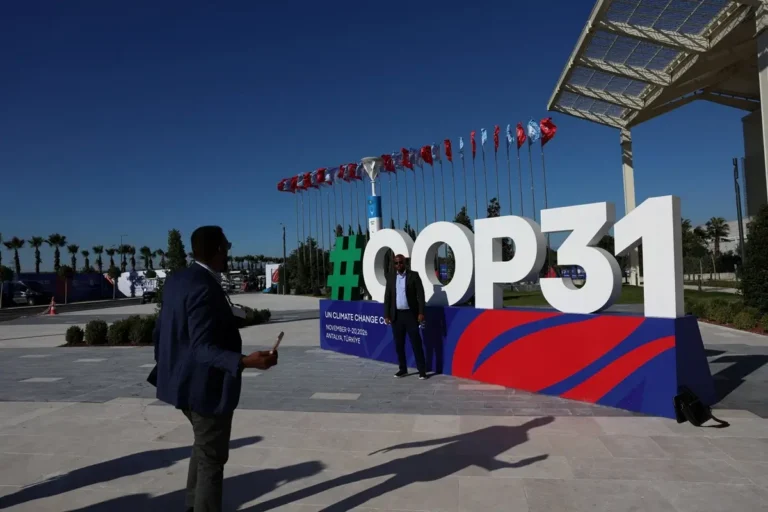
On 16 November, as Harvard’s numbers appeared, negotiators at the COP31 climate talks in Antalya launched the voluntary Antalya Artificial Intelligence Pledge, put forward by host Turkey and the International Telecommunication Union. It says data centres should use clean power and efficient energy and water systems, and that their environmental impacts should be assessed and shared.
Simon Stiell, the UN climate chief, answered the industry’s promises directly: “Claims about future emissions savings cannot excuse rising pollution now.” Al Gore cited a projection by the economist Nicholas Stern of a 6 to 9 percent emissions cut by 2030 from AI-driven efficiency. A projection is not a measurement.
Philip Newell, a spokesman for Climate Action Against Disinformation, puts the campaign view bluntly: “They’re selling us hope while hiding the harms from us.” COP31 President Murat Kurum said world leaders should openly discuss AI’s growing energy consumption.
Fengqi You, an energy systems scientist at Cornell who was not part of the study, says: “We cannot manage environmental impacts effectively without reliable measurements and disclosure.” Harvard calls its count one of the first facility-level estimates since the rise of AI. The tripling is already written down.
BASIS OF ANALYSIS
Basis of analysis. The analysis rests on eight sources, of which the Council’s text of the proposal, the Harvard release and Energinet’s statement are primary or official. The study in Nature Sustainability is reproduced through Harvard’s release and two wire services, and only part of the proposal’s text was read in full. Whether the proposal contains reporting duties for energy, water or emissions could not be confirmed and is left out.
Sources
Harvard T.H. Chan School of Public Health: Hyperscale data centers, energy consumption and carbon emissions newly estimated (16 Nov 2026) – study method, figures and limits.
AP: Study estimates magnitude of US data center pollution as climate talks unveil clean AI pledge (16 Nov 2026) – the Denmark comparison, expert comment and the COP31 pledge.
Reuters via The Star: US hyperscale data centers emit as much as Denmark (16 Nov 2026) – an independent account of the study.
Council of the EU: Proposal for a Cloud and AI Development Act, COM(2026) 502 final (3 Jun 2026) – the tripling aim, market data, grid and sustainability wording.
European Parliament Legislative Observatory: Cloud and AI Development Act summary – procedure and the technological sovereignty package.
Energinet via Ritzau: Energinet vil igen fordele kapacitet i transmissionsnettet (13 Nov 2026) – the grid position on data centres.
TNW: Europe wants to make sure no one has a kill switch over its technology (4 Jun 2026) – the EUR 200 billion estimate and the sovereignty debate.
ITdaily: EU aims to triple data center capacity, but is the plan enough? (9 Jun 2026) – criticism of the plan.