


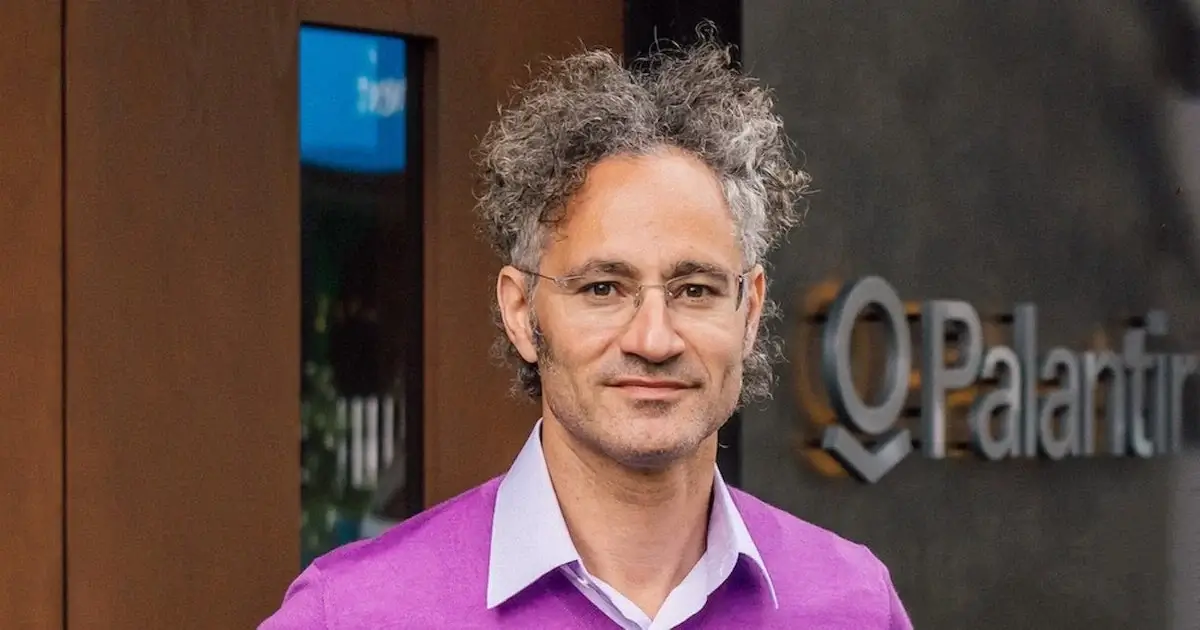
The man who runs a company that sells data platforms to European police forces, ministries of defence and hospitals has bought a forest in Sweden. SCA, the Swedish forestry group, sold about 15,000 hectares in Härjedalen for SEK 235 million. The buyer is Cladonia Skog AB, a newly registered company whose beneficial owner is Palantir chief executive Alex Karp.
Table of contents
The forest tells you little about Palantir. The contracts tell you a great deal, and several of them are harder to find than the forest.
A forest with one name on it
In October a second purchase was reported: two properties of about 300 hectares near Storsjö kapell for SEK 5 million. His company now owns most of the land south of the lake. Hunters who leased land there have received letters saying they can no longer do so. SCA says it leases hunting rights on terms of about eleven months and cannot grant them on land it no longer owns.
Cladonia describes its purpose as forestry and related activities, and a board member says the owner is committed to preserving the land. A private purchase of land is legal, and nothing in the record connects it to Palantir’s business. Palantir does have a partnership with Swedish defence authorities, and Sweden is on the list of European countries where it deals with armed forces or defence ministries, which is why a Swedish forest raises a European question.
Eleven governments buy Palantir
A cross-border investigation led by Follow the Money, with 18 partner newsrooms in 17 countries, counts 11 European countries with national-level Palantir contracts. In eight of them the customer includes the armed forces or the defence ministry: Denmark, Finland, Italy, the Netherlands, Ukraine, Spain, Sweden and the United Kingdom. Norway is discussing the Maven system, and Poland signed a letter of intent in October 2025.
Germany and Belgium do not use Palantir for their national armies. Germany’s state police forces have paid more than €95 million across their contracts.
Bavaria’s contract totals €25,315,935 and runs to April 2027, with four possible one-year extensions. North Rhine-Westphalia has paid more than €47 million since 2019 and relaunched the tender in April 2026. Baden-Württemberg signed a five-year licence worth €25 million in March 2025, though the software is reportedly not yet in use.
Read also: Brussels drafts ban on ten online manipulation tricks
In Britain, the National Health Service data platform went to a Palantir-led consortium in November 2023 as a seven-year contract, first described as £330 million and later as £480 million. About £198.4 million had flowed to Palantir for the platform by March 2026, and a further £69 million went to other health service projects between 2020 and 2024. Counting the health ministry as well, the investigation says the total could exceed £401 million.
The government confirmed in spring 2026 that it would examine whether the contracts continue after a break clause in February 2027.
The Ministry of Defence signed a three-year deal worth £240 million in December 2025. Spain signed a €16.5 million government contract in 2023, and more than 40 Spanish companies are reported to use the software.
Governments that said no, or later
Switzerland is the clearest case. The Swiss army and the federal armaments office examined Palantir several times and declined, and an army staff report concluded that the software does not belong in the army or the secret services. Palantir calls that report second-hand and says it was never contacted. The Swiss magazine Republik has reported that Palantir was turned down at least nine times, for reasons that ranged from lack of need to fear of reputational damage.
The Netherlands has used Palantir since 2010, in a deliberately narrow way according to its Defence State Secretary, Derk Boswijk. He told parliament in June that a full alternative should exist within two years. In Germany the Bundeswehr’s cyber chief, Vice Admiral Thomas Daum, called it “simply inconceivable” to give industry staff access to the national database, and the government is shortlisting European suppliers such as ChapsVision.
Parliamentary committees in London have taken a hard line. One called Palantir’s presence in the health service an “unacceptable point of weakness” and wanted the relationship to end in 2027. A second committee urged the government in July to scrap the contract. In Baden-Württemberg, state premier Cem Özdemir wants Palantir replaced as soon as possible by a European product, and the CDU there wants a European alternative by 2030.
Denmark’s defence ministry would not say in December whether it is phasing Palantir out, and Danish defence and IT firms have since been reported to be building alternatives.
The best argument for staying
Palantir’s answer is that sovereignty depends on who controls the data, the decisions and the mission, and not on the nationality of the supplier. It says some of the most security-conscious and sceptical institutions in Europe are among its customers, and that more than a fifth of its staff are now in Europe.
It says it has worked with European governments since 2011 on hospitals, cancer diagnosis, refugee resettlement and organised crime. Its 2024 German accounts describe every large company and state organisation in the country as a potential customer. A company spokesman has said Palantir has no access to customer data beyond what is necessary, and that access is authorised, logged and audited by the customer.
Read also: What Brazil’s Meta fines mean for the DSA
That argument has a practical side. Boswijk’s two years show that a replacement does not exist today, and a data platform that runs a hospital network or a police analysis system cannot be swapped over a weekend. Customers pay for software that works, and the sources give no sign that the systems fail at their tasks.
Bavaria is in talks with Palantir about the cost, and Norway and Poland are moving closer to the company, so the trend across the continent points in two directions at once.
The weak point is the claim about control. A data protection impact assessment for a pilot at London’s Metropolitan Police, the Culture Standards and Integrity Ecosystem, which ran from October 2025 to April 2026, obtained in June 2026, says it is “not currently clear” whether Palantir would retain data. The London mayor’s office blocked a separate £50 million Met contract with Palantir in May over breaches of procurement rules and extended the pilot by 12 months while the force reruns the tender. Palantir has challenged the block in the High Court.
What the public record leaves out
Two of the contracts above reach a decision point within six months: the health service break clause in February 2027 and the end of Bavaria’s current term in April 2027.
A forest has an owner that a local newspaper can find. The state’s Palantir purchases are harder. Germany’s interior ministry says the ministry, the federal criminal police and the federal police do not use Palantir products. The Chancellery and the intelligence services BND and BfV declined to confirm or deny that they do. The German health ministry answered that it has no need for the software, and Hesse has withheld the costs of its system.
Even where numbers exist, one British contract carries three of them: a £330 million headline, a later £480 million and £198.4 million actually paid, each measuring something different. A parliament comparing offers, or a voter comparing countries, starts with figures that do not match.
Eleven governments have bought the same supplier, and in at least two German institutions the public answer is withheld. The cost of replacing Palantir can only be judged once someone is allowed to see what it costs to keep it.
Part of our guide to Europe’s digital dependence: Europe Runs on Computers It Does Not Own
BASIS OF ANALYSIS
Basis of analysis. The analysis rests on nine sources: one cross-border investigation, a news overview of European re-evaluations, a trade-press account of the NHS contract, a December 2025 trade-press report three reports on the forest purchase and two on the Metropolitan Police contract. No contract text or Palantir filing was read, so every sum is as stated in the sources. The Metropolitan Police developments come from news summaries, not full articles. Recent moves against Palantir in France and Spain and a Swiss court ruling in a dispute with a magazine could only be traced through second-hand summaries and are left out.
Sources
- netzpolitik.org: Länderübergreifende Recherche: Palantirs Geschäfte in Europa (15 Oct 2026) – countries with Palantir contracts, German state police costs, NHS and Ministry of Defence sums, Palantir’s replies.
- Euronews: Why are European governments reevaluating their agreements with Palantir? (5 Jun 2026) – Netherlands, Germany, the UK committee and the Spanish contract.
- Computer Weekly: Palantir: Can anyone else do what it does? (undated) – NHS contract terms, break clause and the Metropolitan Police assessment.
- Ingeniøren: Minister trækkes ind i sag om overvågningsteknologi fra USA (22 Dec 2025) – the Swiss army assessment and Palantir’s response.
- Fortune: Palantir CEO Alex Karp purchased 37,000 acres of forests in Sweden (30 Sep 2026) – the buyer, the stated purpose and the hunting leases.
- Placera/Finwire: SCA säljer skogsmark i Härjedalen till Palantirs vd Alex Karp (28 Sep 2026) – area and price of the first purchase.
- TV4/TT: Omstridde techmiljardären köper mer svensk skog (19 Oct 2026) – the second purchase.
- Novara Media: Sadiq Khan Backtracks on Blocking Palantir From Met Contract (26 Jun 2026) – the blocked £50 million contract and the pilot extension.
- Reuters via The Star: Palantir says UK police contract wrongly blocked over perceived ‘values’ (9 Jul 2026) – Palantir’s High Court challenge.